
Quick answer: Yes. The Yamaha F150 is a dependable choice in the 150 hp class. It has been sold since 2003 and uses a simple in-line four-cylinder, 16-valve design. In the US it carries a 3-year warranty for pleasure use. Long-term reliability still depends on regular maintenance. On a used motor, it depends on a clean service history.
The original Yamaha 150 outboard motor made its debut in 2003, as a 2004 model. Since then it has stayed in production with only small changes to the specs.
Owners use the Yamaha 150hp outboard on boats of around 6.5 m (about 21 feet), pontoon boats, RIBs, power catamarans, tow sports boats and more.
Owners value these motors for their build quality and corrosion protection.
Reviews are mixed, as they are for any popular motor. So the question is simple: is it reliable enough to own? This guide covers specs, versions, prices, common issues, maintenance and what to check before you buy used.
How Good Yamaha 150 Outboard Motors Are?
If I describe this motor in one word, that would be a ‘great’ motor. It is quiet, revs quickly for a four-stroke, has plenty of torque and runs smoothly.
For emissions, check the certification label on the motor. It shows which EPA and California standards that model year meets.
As a modern four-stroke, the F150 burns cleaner than the old carbureted two-strokes it replaced. Real fuel use depends on your hull, load, prop and cruise speed.
Every F150 uses electronic fuel injection (EFI). The 2.8L digital (DEC) version adds electronic throttle and shift. The 2.7L mechanical version uses traditional cable controls. Yamaha lists Variable Camshaft Timing for its F200 In-Line Four, not for the F150.
The F150 works on many hull types, from deep-V hulls to flatboats and pontoons. Before you buy, check your boat’s capacity plate for the maximum horsepower and engine weight it can carry. Ask your dealer whether one motor or twins suit your hull.
It makes 150 hp at 5,500 rpm, with a full-throttle range of 5,000–6,000 rpm.
The extended trim range helps with getting on plane and with top-end speed. It has a full 70° tilt range, so you can tilt the engine above the waterline.
The motor has Yamaha’s variable trolling RPM switch (VTS). It lets anglers adjust trolling speed in 50 rpm steps from 650 to 900 rpm using a Yamaha Command Link gauge.
Yamaha’s exclusive Shift Dampener System significantly reduces the noise of shifting gears and offers smooth, quiet operation.
The F150B model has an updated look. Its lighter composite cowling covers new powerhead cladding (manifold, oil and alternator covers). The design reduces contact between the cowling and powerhead during service.
The composite intake manifold is light and compact. Long-tube intake tracts are tuned to increase airflow.
An air silencer box and surge tank cut intake noise and air turbulence for smoother operation.
What Are the Yamaha F150 Specs?
The table below compares the two F150 In-Line Four versions. All figures come from Yamaha’s official In-Line Four spec page.
| Spec | F150 2.7L (mechanical) | F150 2.8L (digital/DEC) |
|---|---|---|
| Engine type | In-line 4, DOHC, 16-valve | In-line 4, DOHC, 16-valve |
| Displacement | 2.7L | 2.8L (about 2,785cc) |
| Bore | 3.70 in (94 mm) | 3.78 in (96 mm); stroke 96.2 mm |
| Compression ratio | 9.0:1 | 10.3:1 |
| Gear ratio | 2.00:1 | 2.00:1 |
| Alternator | 35 amp | 50 amp |
| Controls | Mechanical (cable) | Digital electronic throttle and shift |
| Recommended fuel | 87 octane | 89 octane |
| Weight (20-inch shaft) | 509 lb (231 kg) | 522 lb (237 kg) |
| Power | 150 hp at 5,500 rpm | 150 hp at 5,500 rpm |
| Full-throttle range | 5,000–6,000 rpm | 5,000–6,000 rpm |
| Spark plug | NGK LFR6A-11 | NGK LFR5A-11 |
| Engine oil capacity | 4.5 L | 4.3 L |
| Tilt range | 70° | 70° |
| Min. twin mounting centers | 26 in (about 660 mm) | 26 in (about 660 mm) |
| Shaft lengths | 20 in, 25 in | 20 in, 25 in |
| US warranty | 3 yr pleasure / 1 yr commercial | 3 yr pleasure / 1 yr commercial |
How Much Does a Yamaha F150 Weigh?
With a 20-inch shaft, Yamaha lists the F150 at 509 lb (231 kg) for the 2.7L mechanical version and 522 lb (237 kg) for the 2.8L digital version. The 25-inch-shaft models weigh more. Check Yamaha’s spec page for the exact figure. Add the weight of the prop, fluids, controls and battery when you check your boat’s capacity plate.
How Reliable Are Yamaha 150hp Outboard Motor?
The F150 has a good track record. Yamaha has refined the same basic platform since 2003 instead of starting over. That gives dealers and mechanics many years of parts and service knowledge.
Various customers report that they are happy with the service.
Even the most ardent critics admit that modern outboard motors have greatly improved their overall reliability.
However, these motors are expensive. Part of the cost goes to materials and coatings meant to resist corrosion.
How Durable Yamaha 150 Outboard Motors Are?
The Yamaha 150hp four-stroke is a popular motor in its class. If you shop new, look at the F150 DEC (Digital Electronic Control) or the VF150 V MAX SHO (Super High Output).
The digital 2.8L F150 has about 2,785cc of displacement (96 x 96.2 mm bore and stroke), a 50-amp alternator and a 2.00:1 gear ratio. The 50-amp alternator helps if you run electronics like fish finders and chartplotters.
Both versions use an in-line four-cylinder, twin-cam (DOHC), 16-valve engine. This simple layout keeps service straightforward.
The slim design and compact powerhead make it suitable for twin-engine installations. Yamaha lists 26-inch (about 660 mm) minimum mounting centers for twin F150s.
The engine is designed for efficient combustion and good acceleration. The 10mm offset crankshaft permits more intake volume.
The connecting rods, crankshaft and gears are heat-treated to increase strength. The four tuned intake tubes increase torque at low and medium speeds.
The body uses Yamaha’s proprietary YDC-30 aluminum alloy and its exclusive Phaze Five electro-deposited anti-corrosion paint system. Together they give a five-layer barrier against corrosion.
What Is the Difference Between the Mechanical and Digital (DEC) F150?
The main difference is how you control the motor. DEC stands for Digital Electronic Control. On the 2.8L DEC model, the throttle and shift work through electronic signals instead of cables. The 2.7L mechanical model uses standard push-pull cables.
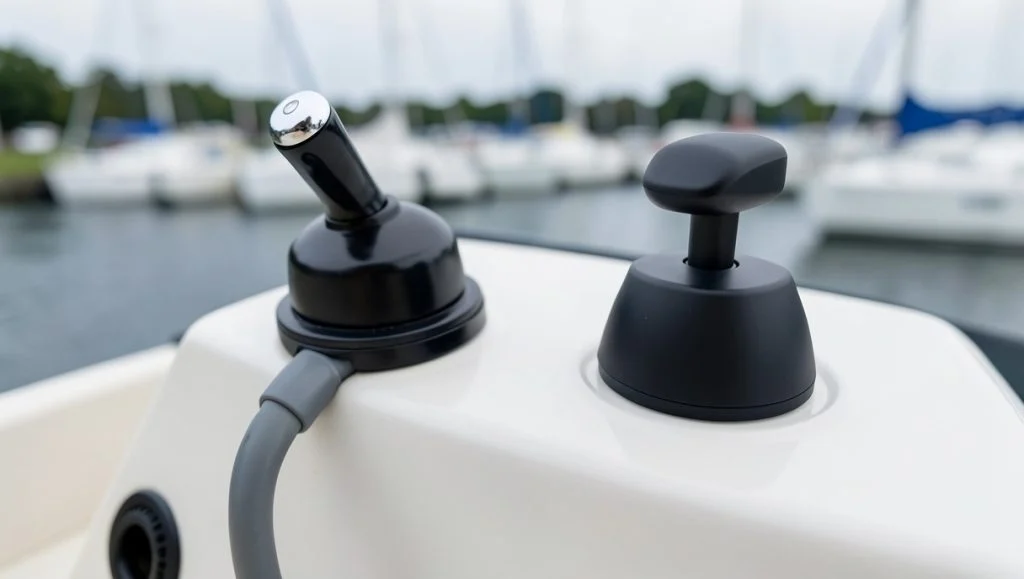
The two versions also differ under the cowling:
- Displacement: 2.7L mechanical vs. 2.8L digital.
- Alternator: 35 amps vs. 50 amps.
- Compression ratio: 9.0:1 vs. 10.3:1.
- Fuel: 87 octane vs. 89 octane.
- Weight (20-inch): 509 lb vs. 522 lb.
Decision rule: Choose the mechanical version if you are repowering a boat with working cable controls and modest electrical needs. It also runs on cheaper 87-octane fuel. Choose the digital version if you want smoother electronic shifting, more charging for electronics, or a new Yamaha control setup.
What About The Older Yamaha 150hp Version?
Back in the mid-1980s, Yamaha was already selling four-stroke outboards, which was unusual at the time. Later, stricter emissions rules pushed the whole industry toward four-strokes.
Yamaha launched the fuel-injected F115 in late 1999, with production starting in November 1999. It followed with the F150 in 2003, sold as a 2004 model.
The F150B is an update of the original F150, with a new cowling and powerhead cladding. If you are comparing an early F150 with an F150B, ask a Yamaha dealer which internal parts changed between the two.
Yamaha currently sells both digital and mechanical versions. The mechanical version displaces 2.7 liters instead of 2.8. It has a 9.0:1 compression ratio and a 3.70” bore, versus 10.3:1 and 3.78” on the digital model. Both use a 2.00:1 gear ratio. The alternator puts out 35 amps instead of 50.
So, the mechanical version suits older boats that already use cable controls.
The F150 has not changed much over the years apart from cosmetic tweaks and minor mechanical updates. That continuity is part of its appeal for owners and mechanics.
Yamaha also built two-stroke 150hp outboards in the early 2000s. These older two-strokes need careful maintenance. Do not confuse them with the four-stroke F150 when you shop used.
What Are The Typical Problems With The Yamaha 150 Outboard Motor?
Yamaha does not publish a list of known faults, so treat owner reports with care. These are the issues worth checking:
- Noise at idle: Some owners of early models have reported a whistling noise at idle. They linked it to the counterbalance assembly. If you hear an unusual whistle or rattle at idle, have a Yamaha dealer diagnose it before you buy.
- Trim gauge readings: Some owners have reported cracked plastic trim senders that cause wrong or jumpy trim gauge readings. If the gauge acts up, check the trim sender first.
- Corrosion: Like any outboard, an F150 run in salt water can corrode if it is not flushed and its anodes are not replaced. Look closely at the lower unit, the bracket and the bottom of the cowling.
- Overheating: A worn water pump impeller or a stuck thermostat can cause overheating on any outboard. A weak telltale stream is a warning sign.
How Long Do Yamaha 150hp Last?
Yamaha does not publish a rated lifespan in hours for the F150. How long one lasts depends mostly on maintenance, running conditions and whether it is used in salt water. A well-kept motor with full service records is a better bet than a low-hour motor with no history.
Engine condition is also one of the biggest factors in a boat’s value.
Since an outboard motor is mounted on the boat’s stern, outside the hull, both its gearcase and propeller are submerged during operation. That’s why proper maintenance is necessary to enhance the lifespan.
How Often Should a Yamaha F150 Be Serviced?
Follow the service schedule in your owner’s manual. It lists intervals by engine hours and by time, and you service at whichever comes first. Most recreational boaters reach the time limit before the hour limit, so plan on a regular service each season.
A routine F150 service usually covers these items:
- Engine oil and filter: The mechanical 2.7L holds 4.5 L of oil. The digital 2.8L holds 4.3 L.
- Gear oil: Drain and refill the lower unit. Milky oil means water is getting in.
- Spark plugs: Use NGK LFR6A-11 on the mechanical model and NGK LFR5A-11 on the digital model.
- Water pump impeller: Inspect it and replace it at the interval in your manual, or sooner if you run in sandy or silty water.
- Thermostats: Check for corrosion and sticking, especially on saltwater motors.
- Fuel filters: Replace the filters and check for water in the fuel.
- Anodes, grease points and prop: Replace worn anodes, grease the fittings and check the prop shaft for fishing line.
Flush the motor with fresh water after every saltwater trip. Keep receipts for every service. They protect your warranty and raise resale value.
What Warranty Does the Yamaha F150 Have?
In the US, Yamaha covers the F150 for 3 years of pleasure use and 1 year of commercial use. Yamaha also sells extended coverage through its Yamaha Extended Service (Y.E.S.) program. Ask your dealer for current Y.E.S. terms, length and price before you buy. When you buy used, confirm whether any factory or Y.E.S. coverage remains and whether it transfers to you.
Do Yamaha 150hp Motors Hold Their Value?
Generally, yes. Yamaha’s reputation for reliability came from years of building quality outboard motors. Good performance, lower running costs and wide dealer support keep demand for used F150s steady.
Resale value depends mostly on condition, hours, service records and freshwater vs. saltwater use. A motor with documented dealer service, clean compression numbers and little corrosion will sell faster and for more. For a price check, compare listings for the same model year and hours in your region.
What Should You Check Before Buying a Used Yamaha F150?
Use this checklist, and have a Yamaha-certified mechanic inspect the motor if you can.
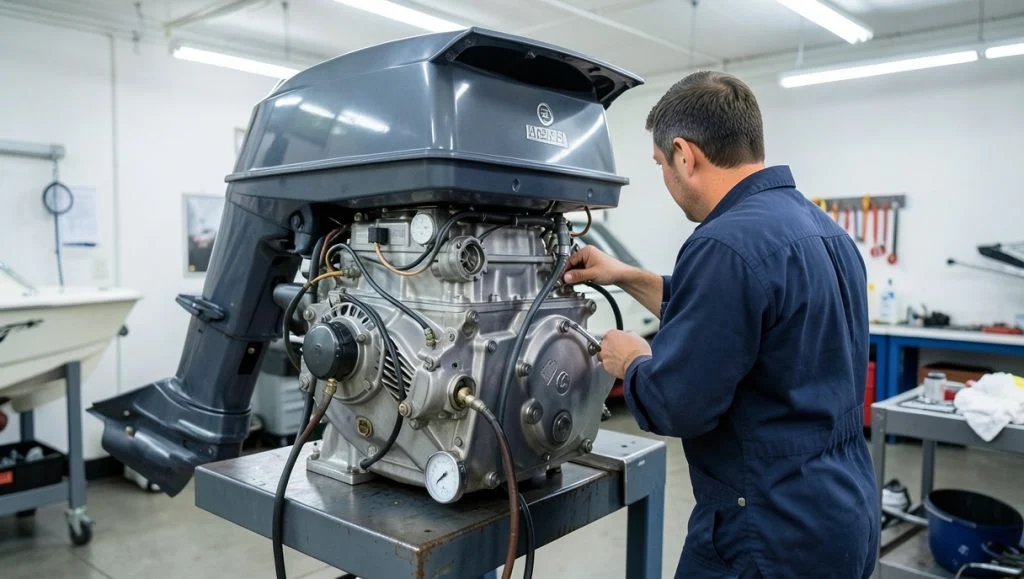
- Check engine hours: A dealer can read hours and engine history with Yamaha’s diagnostic software. Compare the result with what the seller told you.
- Run a compression test: All four cylinders should read close to each other. A low cylinder is a red flag.
- Ask for service records: Look for regular oil, gear oil, impeller and plug changes.
- Inspect for corrosion: Check the lower unit, bracket, cowling base and electrical connections.
- Check the gear oil: Milky oil or metal flakes point to seal or gear problems.
- Listen at idle: Note any whistle, knock or rough running.
- Water test it: Confirm it reaches the 5,000–6,000 rpm full-throttle range with the right prop. Watch for a strong telltale stream and no overheat alarms.
- Confirm the version: Make sure it is the 2.7L mechanical or 2.8L digital model you expect, and that it matches your controls.
Which Is Better: Yamaha F150 or Mercury 150 FourStroke?
Neither is better for every boat. The Yamaha F150, Mercury 150 FourStroke, Suzuki DF150 and Honda BF150 are all established 150 hp four-strokes. The right pick usually comes down to practical factors:
- Dealer support: Buy the brand with a good service dealer near where you boat. This matters more than small spec differences.
- Existing rigging: If your boat already has Yamaha controls and gauges, staying with Yamaha can cut repower costs.
- Weight: Compare each motor’s official dry weight for your shaft length against your boat’s capacity plate.
- Warranty: Compare base warranty length and extended coverage options from each brand.
- Installed price: Get written quotes that include rigging, controls and prop, not just MSRP.
For brand-level detail, see our reviews of Mercury outboards, the Suzuki 150 and Honda outboards.
Are Yamaha 150hp motors Still Being Made?
Yes, Yamaha 150hp motors are still being manufactured. The current US lineup includes:
- F150 In-Line Four, 2.7L mechanical: 20-inch and 25-inch shafts.
- F150 In-Line Four, 2.8L digital (DEC): 20-inch and 25-inch shafts.
- VF150 V MAX SHO, 2.8L: a separate 150 hp model in Yamaha’s V MAX SHO line.
Pick the F150 if you want Yamaha’s long-running general-purpose 150. Look at the VF150 V MAX SHO if you are shopping Yamaha’s performance line. Compare both spec sheets for weight and features before you decide.
How Much Does a New Yamaha 150 hp Outboard Cost?
Older figures of $8,400–$9,253 no longer match Yamaha’s US prices. Yamaha’s price list effective July 1, 2026 sets these MSRPs:
| Model | MSRP (Jan 2026) | MSRP (July 1, 2026) |
|---|---|---|
| VF150LB V MAX SHO | $19,780 | $19,880 |
| VF150XB V MAX SHO | $19,885 | $19,985 |
For F150 In-Line Four pricing, check the same official price list for the exact model rows. MSRP does not include rigging or installation. Controls, gauges, a prop and labor can add a lot to the final bill, so ask for an installed quote.
Some of you may think that Yamaha outboard motors come with a higher price tag.
You pay for build quality, easy-to-service design, corrosion protection and materials like Yamaha’s YDC-30 alloy. You also get a wide dealer network for service and parts.
What Do the LB, XB, LCA and XCA Codes Mean?
The letters in a Yamaha model name describe the shaft length and rotation. In Yamaha’s naming, L generally means a 20-inch shaft and X a 25-inch shaft. A C usually marks a counter-rotation model, used on the second motor of a twin setup so the props turn in opposite directions. The last letter (such as B) refers to the model generation. So a VF150LB is a 20-inch-shaft model and a VF150XB is a 25-inch model. Always confirm shaft length and rotation on the spec sheet before you order, because the wrong shaft length can hurt performance.
Final Words
The mid-sized F150 is one of Yamaha’s best-known outboards. It has a 10mm offset crankshaft for more intake volume, variable trolling control in 50 rpm steps, a shift dampener for smoother, quieter gearshifts, and a 3-year US pleasure-use warranty. Choose the 2.7L mechanical version for simple cable-control repowers, or the 2.8L digital version for electronic controls and more charging. On a used motor, check the hours, compression, corrosion and service records before you buy. Have any idle noise checked, since some owners have reported it on early models.
Related Posts:
- Suzuki 300 Outboard Review: Are They Good and Reliable?
- Suzuki Outboards Reviews: Are They Good and Reliable?
- Honda Outboards Review: Are They Good And Reliable?
- Mercury Outboard Reviews: Are They Good and Reliable?
- Suzuki 150 Outboard Reviews: Are They Good and Reliable?
Yamaha F150 FAQs
What fuel does the Yamaha F150 need?
The 2.7L mechanical F150 is rated for 87-octane fuel, and the 2.8L digital (DEC) F150 calls for 89 octane. That makes the mechanical version a bit cheaper to fuel. Replace the fuel filters at each service and check for water in the fuel to protect the fuel injection system.
Can you run twin Yamaha F150 outboards?
Yes. The F150’s slim design and compact powerhead suit twin-engine installs, and Yamaha lists 26-inch (about 660 mm) minimum mounting centers. Twin setups usually pair a standard motor with a counter-rotation model so the props turn in opposite directions. Check your boat’s capacity plate for total horsepower and weight first.
What is the full-throttle RPM range of the Yamaha F150?
Both F150 versions make 150 hp at 5,500 rpm and have a full-throttle range of 5,000–6,000 rpm. With the right prop, the motor should reach that range at wide-open throttle. If it falls short, have the prop, the load and the engine’s condition checked.
Is the Yamaha F150 good for saltwater use?
Yes, with proper care. The F150 uses Yamaha’s YDC-30 aluminum alloy and Phaze Five anti-corrosion paint for a five-layer corrosion barrier. You still need to flush it with fresh water after every saltwater trip, replace worn anodes and inspect the lower unit, bracket and cowling base for corrosion.
What does the Yamaha F150 variable trolling switch do?
The variable trolling RPM switch (VTS) lets anglers fine-tune trolling speed. It adjusts engine speed in 50 rpm steps from 650 to 900 rpm using a Yamaha Command Link gauge. This gives finer speed control when fishing at slow speeds.
How much oil does a Yamaha F150 hold?
The 2.7L mechanical F150 holds 4.5 L of engine oil, and the 2.8L digital F150 holds 4.3 L. Change the oil and filter at the interval in your owner’s manual. Most recreational boaters reach the time limit before the hour limit, so plan on one oil change each season.
