Quick answer: The most common MacGregor 25 sailboat problems are a worn or corroded keel cable, a rusting cast-iron swing keel, leaks at the keel pivot bolt, cracks in the thin, flexing hull, and tired stainless rigging. Outboard setup issues are also common. Production ended in 1987, so every boat is now decades old. Condition matters more than the model.
The MacGregor 25 is a small, trailerable pleasure sailboat designed by Roger MacGregor. MacGregor Yacht Corporation built it in the United States from 1973 to 1987. In its early production years, the MacGregor 25 was sold under the name Venture 25.
During the 14 years of production, about 7,000 boats were built. That is a large number for a small sailboat, so used boats are still easy to find. The builder is gone, though. MacGregor Yacht Corporation closed its factory in 2013. Every MacGregor 25 for sale today is a used boat that is at least several decades old.
The boat has a good reputation, but some problems are worth knowing before you buy one. This article covers each problem, how to check for it, and what to do about it.
What Are the MacGregor 25 Specs?
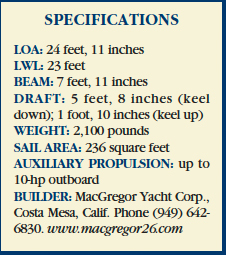
The MacGregor 25 is a sailboat, not a powerboat. It has a fractional sloop rig, a stub keel with a centerboard (often called a swing keel), and a rudder mounted on the transom. Here are the core specs from the MacGregor 25 entry on Wikipedia:
| Spec | MacGregor 25 |
|---|---|
| Length overall (LOA) | 25.0 ft |
| Waterline length (LWL) | 23.0 ft |
| Beam | 7.92 ft |
| Draft, board down | 5.67 ft |
| Draft, board up | 1.5 ft |
| Displacement | 2,100 lb |
| Ballast | 625 lb |
| Sail area | 250.5 sq ft |
| Rig | Fractional sloop |
| Keel | Stub keel with centerboard (swing keel) |
| Rudder | Transom-mounted |
| Years built | 1973 to 1987 |
What Are the Most Common Problems with the MacGregor 25 Sailboat?
There is no doubt that the MacGregor 25 is a remarkable sailboat. But no boat is free of problems, and that goes for the MacGregor 25 too. Most issues come from age, salt water, and the light build that makes the boat easy to trailer.
1. Outboard Setup Problems
The MacGregor 25 works with outboards. It has an adjustable outboard bracket on the transom and normally uses a 3 to 6 hp outboard. The trouble usually comes from a poor match between the motor, the bracket, and the boat.
On owner forums, people describe motors that kick up in reverse instead of staying locked down, rough shifting, and throttles that are hard to control. These reports are anecdotes, not test results. But they point to the parts worth checking on any boat you look at.
Before you buy a motor or a boat with a motor, check these points:
- Power: stay in the 3 to 6 hp range the boat normally uses. More power adds weight on the transom without much gain.
- Shaft length: match the shaft to the bracket height so the prop stays deep in the water when the boat pitches. A shaft that is too short lets the prop suck air.
- Bracket: look for cracks, bent arms, loose bolts, and soft wood or core behind the transom mounting.
- Reverse lock: make sure the motor’s tilt lock holds in reverse. If it does not, the motor can kick up when you back out of a slip.
- Controls: test shifting and throttle on the water, not just on the trailer.
2. Issue With Locking the Keel
Locking the swing keel in place can be a challenge. Owners on forums say it is easier to line up the locking point at the dock than under way. They also report that an unlocked keel can swing back while motoring. In a shallow or narrow berth, a keel that is not where you think it is raises the chance of touching bottom.
Some owners suggest adding a jam cleat (for example, the Nautos CL257) to hold the keel line. Whether it fits your boat depends on how your keel line and winch are set up. Check the layout before you buy hardware.
Simple habit helps too. Always know the keel position before you enter shallow water. If your berth is shallow, raise the keel before you get close.
3. Worn Keel Cable and Winch
The keel is raised and lowered by a cable and winch. Over the years, the cable and its end fitting can corrode, according to Good Old Boat’s used-boat review. A broken cable can let the keel drop all the way down without warning. That is a real risk in shallow water or on a ramp.
Inspect the full cable when the keel is down. Look for broken strands, rust stains, kinks, and a loose or cracked end fitting. Check that the winch holds without slipping and that any pulleys turn freely.
How Do You Replace the Keel Cable on a MacGregor 25?
The exact steps depend on how your boat is rigged, so follow an owner guide for your model year if you can. The general process looks like this:
- Put the boat on its trailer or on a solid support on level ground.
- Lower the keel onto a padded block or support so the cable carries no load. Never work under a keel held up only by the cable.
- Remove the old cable from the winch, the pulleys, and the keel end fitting.
- Inspect the winch, pulleys, and the keel attachment point while you have access. Replace anything worn.
- Fit a new cable of the same size and material, with matching end fittings.
- Seal the cable’s deck or hull entry point so water stays out.
- Raise and lower the keel several times on land. Check that the winch holds at every position.
If you are not sure about any step, have a boatyard do the job. A falling keel can cause serious injury.
4. Corroded Cast-Iron Keel and Leaking Pivot Bolt
The keel ballast is exposed cast iron. Good Old Boat notes that it can corrode badly, especially in salt water. The keel pivot bolt can also leak and suffer from electrolysis.
- Look for flaking rust, pitting, and swelling on the keel surface.
- Check inside the boat around the pivot bolt for water stains, rust trails, or damp wood.
- Look for white or crusty deposits on the bolt and nearby metal, which can point to electrolysis.
- Rock the keel gently. Too much side-to-side play can mean a worn pivot.
5. Variable Build Quality and Hull Cracks
Every MacGregor 25 today comes from a past owner, not the factory. A few boats were built with a masthead sloop rig in 1980, while most have the fractional rig. On top of that, each boat has its own history of repairs and upgrades. You may not know if an original part was swapped for a poor-quality one.
The hull is thin and flexes, so look for cracks. Check these areas closely:
- Hull: stress cracks near the keel trunk, the bow, and where the trailer bunks press.
- Blisters: small bubbles in the bottom paint or gelcoat.
- Deck and transom: tap with a plastic mallet. A dull thud instead of a sharp sound can mean a soft or wet spot. Press with your weight to feel for give.
- Leaks: water stains under deck fittings, windows, the hatch, and the mast base.
Because condition varies so much, do your research and buy from a seller you can trust. A survey (covered below) is the best protection.
6. Aging Rigging, Chainplates, and Mast Step
The standing rigging is light stainless steel. Plan to replace much of it on an older boat. A failed shroud or stay can bring the mast down.
- Wires: look for broken strands, rust, and kinks, especially at the swaged ends.
- Chainplates: check for cracks, rust stains, and leaks where they pass through the deck.
- Mast step: check for cracks, crushing, or a sagging deck under the mast.
- Mast-raising gear: since you raise the mast often on a trailer sailer, check hinges, pins, and lines.
7. Rudder and Rudder Bracket Wear
The rudder hangs on the transom. On any boat this old, the hardware that holds it deserves a close look.
- Check the brackets and pins for cracks, bends, and worn holes.
- Wiggle the rudder. Too much play means worn hardware.
- Look for soft spots in the transom around the mounting bolts.
- Inspect the rudder blade for cracks, swelling, or water weeping out.
- If the rudder kicks up, make sure it locks down fully and releases as it should.
8. Trailer Condition
Most MacGregor 25s are sold with a trailer, and the trailer is often as old as the boat. A bad trailer can damage the hull or fail on the road.
- Check the frame for rust, cracks, and bent sections, especially if it has been dunked in salt water.
- Look at tire age and tread, wheel bearings, and lights.
- Make sure bunks or rollers support the hull evenly.
- Check the winch, strap, and safety chains.
- Confirm the trailer has a valid title or registration where your state requires it.
How Much Does a MacGregor 25 Weigh on a Trailer?
The boat’s displacement is 2,100 lb. The total weight on the road is higher once you add the trailer, motor, fuel, sails, batteries, and gear. The trailer’s own weight varies by model. To know your real towing weight, take the loaded rig to a public scale, such as one at a truck stop. Then compare it with your vehicle’s tow rating.
9. Value Can Vary a Lot from Boat to Boat
The MacGregor 25 is not a million-dollar yacht. But asking prices can swing widely based on condition, the trailer, the motor, the sails, and the seller. Some sellers ask more than the boat’s condition supports.
Keep comparisons fair. The MacGregor 25 is a sailboat, so comparing it with powerboats is not useful. For example, Crestliner builds welded aluminum fishing boats and pontoons, mostly for lakes and inland waters. Those are powerboats with different costs and uses. Compare a MacGregor 25 with other small trailerable sailboats instead.
How Much Is a Used MacGregor 25 Worth?
A used MacGregor 25 is worth what similar boats in similar condition sell for in your area. To judge a fair price:
- Look at several current listings for MacGregor 25 and Venture 25 boats near you.
- Note what each includes: trailer, outboard, sail inventory, and electronics.
- Subtract the cost of known repairs, such as new rigging, a new keel cable, keel rust treatment, or trailer work.
- Use a survey report to back up your offer.
10. Mixed Reports on Rough-Water Comfort
Owner reviews are mixed on how the MacGregor 25 handles rough water. Some owners describe a rough ride in open water. Others say it is quite smooth. With a 2,100 lb displacement and 625 lb of ballast, it is a light boat, and light boats tend to feel the waves more.
The best way to settle this is a test sail. Ask the seller to take you out in some wind and chop before you commit.
Can a MacGregor 25 Sail Offshore or in the Ocean?
The MacGregor 25 was built as a light trailerable sailboat. It is best suited to lakes, bays, and coastal day sailing in good weather. It is not a bluewater boat. If you take it on the ocean, stay close to shore, watch the forecast, reef early, and make sure the rigging, keel cable, and hull are in good shape first.
11. No Longer in Production
Being out of production is both a drawback and a point of pride. In 2000, the MacGregor 25 was inducted into the American Sailboat Hall of Fame with this citation:
“Fostering new enjoyment and growth in the sport of sailing through excellent design”
If you like classic boats with a history, the MacGregor 25 can be a worthy option. With about 7,000 built, it is not rare, but good examples are getting older every year.
The downside is support. MacGregor 25 production ended in 1987, and MacGregor Yacht Corporation closed its Costa Mesa factory in 2013. There is no factory service anymore. Parts are still available, though. Tattoo Yachts in Stuart, Florida, took over the dealer network and parts supply chain, and many aftermarket parts fit the boat.
Where Can I Buy Parts for a MacGregor 25?
- Tattoo Yachts: the Stuart, Florida, company that inherited MacGregor’s dealer network and parts supply chain.
- Aftermarket suppliers: general sailboat hardware, rigging, and outboard brackets from marine stores. Many fit or can be adapted.
- Rigging shops: a local rigger can make new standing rigging from your old wires as patterns.
- Owner groups and forums: the MacGregor 25 has a large owner community. Owners share part numbers, sources, and repair tips, and some sell used parts.
12. No Factory Customer Service
Since the factory is closed, you will either have to help yourself or get help from an expert. Take this into account before buying any boat that is no longer made.
A few ways to get around this:
- Buy from a seller or broker with a solid local reputation, and ask in writing what, if anything, they will stand behind after the sale.
- Find a local boatyard or mechanic who works on small sailboats and outboards.
- Join an owner group early. It is the closest thing to customer support for this model.
Be careful with short-lived sellers that may go out of business after a year or two. Any promise they make goes away with them.
What Should You Check Before Buying a Used MacGregor 25?
Use this checklist on any boat you look at:
- Keel: rust and pitting on the cast iron, play at the pivot, leaks or electrolysis at the pivot bolt.
- Keel cable and winch: broken strands, corrosion at the end fitting, a winch that slips.
- Hull: cracks from flexing, blisters, and old repairs.
- Deck and transom: soft spots and leaks at fittings.
- Rigging: age and condition of all stainless wires and fittings.
- Chainplates and mast step: cracks, rust stains, and deck sag.
- Rudder: bracket cracks, worn pins, and play.
- Outboard and bracket: 3 to 6 hp, correct shaft length, solid mount, reverse lock that holds.
- Sails: tears, stretched shape, and brittle cloth.
- Trailer: frame rust, tires, bearings, lights, and paperwork.
- Test sail: raise the keel and mast, sail it, and motor in forward and reverse.
Survey advice: hire a marine surveyor who knows small trailer sailers. Ask them to inspect the keel, keel cable, pivot bolt, and rigging closely, and to look at the trailer too. A survey costs money, but it can save you from buying a boat that needs more work than it is worth.
Is the MacGregor 25 a Good Beginner Sailboat?
Yes, for many beginners it is a good choice, if the boat is in sound condition. Its Hall of Fame citation praises it for bringing new people into sailing. It has a simple fractional sloop rig. It fits on a trailer, so you can store it at home. With the board up, it draws only 1.5 ft, so you can reach shallow water and launch at ramps.
The catch is age. A beginner may not spot a worn keel cable or tired rigging. Bring an experienced sailor or a surveyor when you shop.
How Does the MacGregor 25 Compare with Similar Trailer Sailers?
Buyers often cross-shop the MacGregor 25 with other small trailerable sailboats, such as the Catalina 22, the Venture 222, and the MacGregor 26. Each is a different design. Compare them on the same points:
- Keel type and draft: how shallow you can go and how the keel is raised.
- Displacement and ballast: towing weight and how steady the boat feels in wind.
- Interior space: berths, headroom, and storage for overnight trips.
- Parts and owner support: how easy it is to get parts and advice today.
- Condition of the actual boat: on boats this old, condition usually matters more than the model.
What Is the Difference Between the MacGregor 25 and MacGregor 26?
They share a builder name, but they are separate models with different designs. Do not assume parts, keel hardware, or rigging interchange. Compare the spec sheets side by side, and ask owner groups which parts fit each boat.
General Pros and Cons of the MacGregor 25 Sailboat:
Beyond the problems above, here are the general pros and cons. They can help you decide whether this boat fits your plans.
Pros
- Trailerable, with a shallow 1.5 ft draft when the board is up.
- The boat was inducted into the American Sailboat Hall of Fame in 2000.
- About 7,000 were built, so used boats are easy to find.
- The MacGregor 25 is also a great-looking classic boat.
- Simple fractional sloop rig that suits newer sailors.
- Although the factory is closed, Tattoo Yachts took over the parts supply chain, and there is a large owner community.
- Even if you can’t get the exact part, there are compatible aftermarket parts available for this boat. These parts are great to keep the boat up and running.
Cons
- The outboard must be matched to the bracket and transom (normally 3 to 6 hp).
- Keel cable, cast-iron keel, and pivot bolt need regular checks.
- Thin, flexing hull can develop cracks.
- Light stainless rigging often needs replacing on older boats.
- No factory customer support since the factory closed in 2013.
- Some owners report a rough ride in open water.
- Sometimes, the dealer or owner can ask for prices that the boat’s condition does not support.
Conclusion
Don’t underestimate the MacGregor 25 sailboat just because it isn’t in production anymore. During its 14 years of production, about 7,000 boats were built, and many are still sailing. The boat was inducted into the American Sailboat Hall of Fame for its design. Still, every one is now an old boat. Check the keel, keel cable, pivot bolt, hull, rigging, and trailer, get a survey, and you can find a good MacGregor 25 that will serve you well.
Related Posts:
- Most Common Problems with Yamaha AR230 Boats
- 5 Most Common Problems With Lowe Stinger 175
- 4 Most Common Problems With Phoenix Bass Boat
- 5 Most Common Problems With Robalo 226 Cayman Boat
- 3 Most Common Problems With Robalo R160
MacGregor 25 Sailboat FAQ
What size outboard motor does a MacGregor 25 need?
A MacGregor 25 normally uses a 3 to 6 hp outboard on its adjustable transom bracket. More power adds weight on the transom without much gain. Match the shaft length to the bracket height so the prop stays deep in the water, and make sure the tilt lock holds in reverse.
Is the MacGregor 25 the same boat as the Venture 25?
Yes. In its early production years, the MacGregor 25 was sold under the name Venture 25. When you shop for a used boat, search for both names. Compare listings on the same points, such as condition, trailer, outboard, and sails, since the boat’s history matters more than the name.
When was the MacGregor 25 built?
MacGregor Yacht Corporation built the MacGregor 25 in the United States from 1973 to 1987. About 7,000 boats were made during those 14 years. Because production ended in 1987, every MacGregor 25 for sale today is a used boat that is several decades old, so condition matters more than the model.
How shallow can a MacGregor 25 go?
With the swing keel raised, a MacGregor 25 draws only 1.5 ft. With the board down, draft is 5.67 ft. The shallow board-up draft lets you reach shallow water and launch at ramps. Always know where the keel is before you enter shallow water, and raise it before you get close.
Does MacGregor still make sailboats?
No. MacGregor Yacht Corporation closed its Costa Mesa factory in 2013, so there is no factory service. Tattoo Yachts in Stuart, Florida, took over the dealer network and parts supply chain. Aftermarket suppliers, local riggers, and owner groups also help keep older MacGregor 25 boats sailing.