Quick answer: Choose the Yamaha F300 if low weight and strong local dealer support matter most. It weighs about 560 lb, roughly 70 lb less than the Suzuki DF300AP. Choose the Suzuki if you want Selective Rotation for twin rigs, Lean Burn fuel control and a 5-year pleasure-use warranty. Yamaha’s base warranty is 3 years.
Yamaha and Suzuki are two of the best-known outboard brands in the US, and both build a 300 hp V6. Mercury also competes in the 300 hp class. This article focuses on the Yamaha and the Suzuki.
In this article, I compare the Suzuki 300 and the Yamaha 300 outboard on specs, weight, fuel systems, warranty and service. I also give clear rules to help you decide which one to buy.
Which Suzuki 300 and Yamaha 300 models does this compare?
This comparison covers two specific engines:
- Yamaha F300 (V6 4.2L): Yamaha’s mainstream 300 hp four-stroke.
- Suzuki DF300AP: Suzuki’s current 300 hp four-stroke with drive-by-wire controls and Selective Rotation.
Both brands sell other 300 hp versions with different features. If you are looking at a different variant or an older model year, check that engine’s spec sheet. Weight and features can differ.
Comparison Chart: suzuki 300 vs yamaha 300 outboard
| Suzuki 300 | Yamaha 300 |
| Suzuki Electric start system. | Yamaha Electric start system. |
| Lifespan: no verified hour figure. It depends on maintenance and use. | Lifespan: no verified hour figure. It depends on maintenance and use. |
| Fuel delivery system is Multipoint Sequential Electronic Fuel Injection along with Oxygen Sensor and Lean Burn. | Electronic Fuel Injection (EFI). |
| Tilt System: Power Trim & Tilt | Tilt System: Power Trim & Tilt |
| 6 cylinder (V6, 4,028 cc) | 6 cylinder (V6, 4,169 cc) |
| Remote control and digital electrical control. | Remote control and digital electronic control. |
| Selective Rotation: one engine can be set to turn either way. | Check the spec sheet for rotation options. |
| Heavier than Yamaha: 626–659 lb depending on shaft length. | Lighter than Suzuki: about 550–560 lb depending on controls. |
| Lean Burn control for cruise-speed fuel economy. | EFI. Real fuel burn depends on hull, prop and load. |
| Warranty: 5 years pleasure use, 1 year commercial (US). | Warranty: 3 years standard; promotions have added 2 years of Y.E.S. coverage. 1 year commercial. |
| Price: get quotes from local dealers. | Price: get quotes from local dealers. |
What are the core specs of the Suzuki DF300AP and Yamaha F300?
Both are 24-valve DOHC V6 engines. The Yamaha has a slightly larger displacement. The Suzuki uses a shorter stroke. Figures come from the Yamaha F300 spec sheet, the Suzuki DF300AP spec page and Suzuki USA.
| Spec | Suzuki DF300AP | Yamaha F300 (V6 4.2L) |
| Engine layout | DOHC 24-valve V6 | DOHC 24-valve 60-degree V6 |
| Displacement | 4,028 cc | 4,169 cc |
| Bore x stroke | 98 x 89 mm | 96 x 96 mm |
| Rated output | 300 hp | 300 hp at 5,500 rpm |
| Full-throttle range | See Suzuki spec sheet | 5,000–6,000 rpm |
| Gear ratio | 2.08:1 | See Yamaha spec sheet |
| Fuel system | Multipoint sequential EFI, O2 sensor, Lean Burn | EFI |
| Rotation | Selective Rotation (either direction) | See Yamaha spec sheet |
| Weight | 626 lb (20″), 639 lb (25″), 659 lb (30″) | About 560 lb (digital), about 550 lb (mechanical) |
A spec marked “see spec sheet” means I could not verify that figure for this article. Check the manufacturer’s page for your exact model before you buy.
In-depth Comparison Between Suzuki 300 and Yamaha 300 outboard
Build Quality
Both outboards are solidly built for serious offshore and inshore use.
Yamaha 300 and Suzuki 300 outboard is made of Aluminum alloy along with high-pressure die-casting. And both have Anti-Corrosion Systems to protect them.
Noise level
Some owners say the Suzuki 300 runs quieter and smoother than the Yamaha 300. I could not find measured, side-by-side sound or vibration data to confirm this. Treat it as opinion, not fact.
Noise and vibration also depend on the hull, the mounting, the prop and the engine height. The best test is a sea trial. Ride on a similar boat with each engine at cruise speed. Judge whether you can talk at normal volume.
How much does a Yamaha 300 outboard weigh?
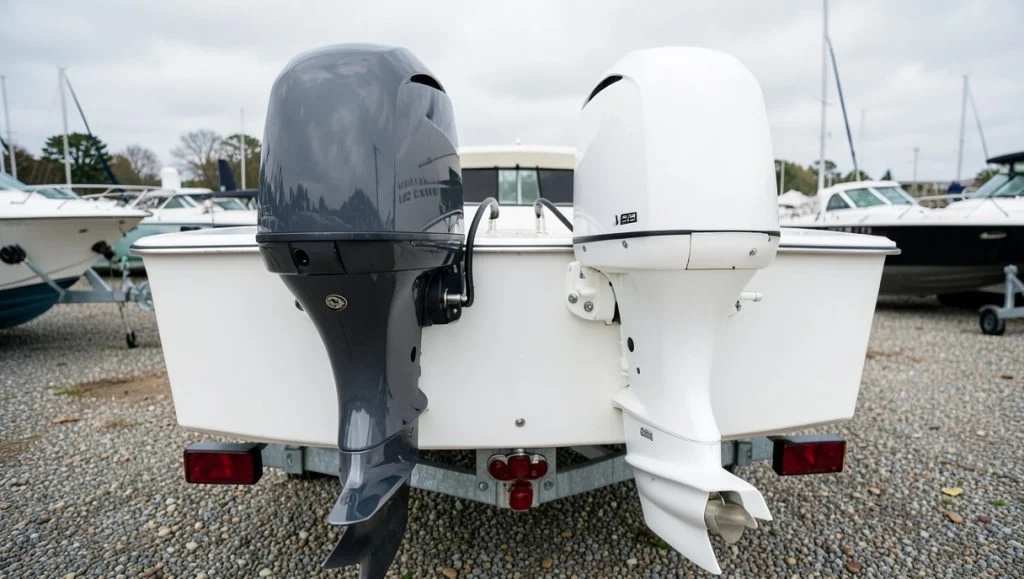
Yamaha 300’s are a little lighter than the Suzuki’s. For example, Yamaha’s digital engine weight is around 560 pounds, and the mechanical one is around 550 pounds which are around 70 pounds lighter than its competitors, along with Suzuki.
How much does a Suzuki DF300 weigh?
Suzuki USA lists the DF300AP at 626 lb with a 20-inch shaft, 639 lb with a 25-inch shaft and 659 lb with a 30-inch shaft.
Why it matters: the weight gap grows on twin and triple rigs. Two DF300APs on 25-inch shafts add up to 1,278 lb. Two Yamahas at about 560 lb add up to about 1,120 lb. Extra weight on the transom affects how the boat sits and planes. Check your boat’s transom weight rating before you choose.
Fuel Economy
Real fuel burn is often worse than the numbers in ads, and that is true for both Suzuki and Yamaha outboards.
The Suzuki 300 uses Lean Burn control. It is designed to lean out the fuel mix at cruise speeds to save fuel. The Yamaha F300 uses electronic fuel injection. Many owners say the Suzuki burns less fuel. I could not verify a specific percentage, so I won’t give one.
Fuel burn depends heavily on your hull, prop, load and trim. If you plan to run 80 to 120 gallons per trip, small differences add up. Look for published boat tests that use your hull model with each engine. Compare gallons per hour and miles per gallon at the same cruise speed.
Brand Recognition
Both Yamaha and Suzuki produce great engines and are well-known as trusted brands. Yamaha has been producing outboards since 1960. Suzuki also has decades of outboard history.
So, both have a long history in the outboard market. In the US, you will usually see Yamaha engines more often at the dock than Suzuki engines. Mercury is another major name in the 300 hp class.
Is Suzuki owned by Yamaha?
No. Suzuki and Yamaha are separate Japanese companies. They design and sell their outboards independently. Their dealer networks and warranties are separate too.
Which one costs less?
Many buyers find the Suzuki 300 priced below the Yamaha 300. However, I could not verify a current price gap, so I won’t quote a dollar figure. Prices change with dealer, region, controls, shaft length, rigging and promotions.
To compare fairly, ask at least two dealers for each brand for an installed quote. Make sure each quote includes the same items: controls, gauges, prop, rigging and labor.
What is the warranty on a Suzuki 300 vs a Yamaha 300?
In the US, Suzuki’s standard warranty is longer. Suzuki gives 5 years for pleasure use and 1 year for commercial use, per its limited warranty document revised April 2026. Yamaha’s standard four-stroke warranty is 3 years.
| Warranty (US) | Suzuki 300 | Yamaha 300 |
| Standard, pleasure use | 5 years | 3 years |
| Promotions | A 7-year promo for 150–350 hp pleasure models ended July 31, 2026 | Promotions have added 2 years of Y.E.S. extended coverage, for 5 years total |
| Commercial use | 1 year | 1 year |
Promotions come and go. Before you buy, ask the dealer which warranty applies on your purchase date. Get it in writing. Also ask what corrosion coverage is included, since the terms are spelled out in each brand’s warranty document.
How do dealer networks and service compare?
Many owners pick Yamaha because Yamaha dealers are easier to find in many areas. I could not verify a national dealer ratio, so I won’t give one. Coverage varies a lot by region.
How to check your area:
- Use each brand’s official dealer locator for your home ZIP code.
- Repeat the search for the places you boat most, such as your marina or a travel destination.
- Call the nearest two dealers. Ask how long the wait is for service and whether they stock common 300 hp parts.
A good dealer close to you matters more than the brand name. A great engine with no nearby service can leave you waiting for weeks.
Which has better resale value?
Many boaters believe Yamaha engines are easier to resell because they are common in the US. I could not verify resale data, so treat this as a general view. Your resale value will depend more on hours, service records and condition than on the brand alone. Keep every service receipt.
What features are unique to each engine?
Suzuki DF300AP features
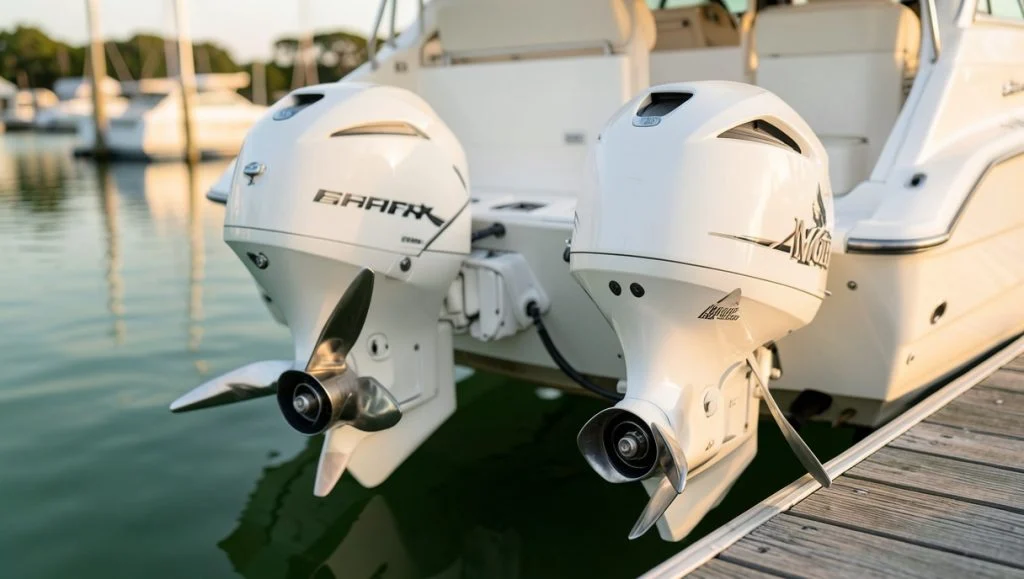
- Selective Rotation: One engine can be set to turn either way. On a twin rig, you can run counter-rotating props without buying two different engine models.
- Lean Burn control: Adjusts the fuel mix for better economy at cruise.
- Multipoint sequential EFI with an O2 sensor: Meters fuel to each cylinder and monitors the exhaust.
- Drive-by-wire controls: Digital electronic throttle and shift.
Yamaha F300 features
- Lower weight: About 550–560 lb, depending on mechanical or digital controls.
- Larger displacement: 4,169 cc V6 with a square 96 x 96 mm bore and stroke.
- Digital electronic control (DEC): Drive-by-wire throttle and shift, or mechanical remote control.
- Wide full-throttle range: 5,000–6,000 rpm, which helps with prop selection.
Which is more reliable, Suzuki or Yamaha outboards?
Both Suzuki and Yamaha are reliable motor brands in the outboard industry. I could not find verified data that shows one 300 hp engine is more reliable than the other. Claims either way are mostly owner opinion.
The motors of Suzuki and Yamaha last thousands of hours with proper maintenance. In practice, reliability depends on how well the engine is cared for. To judge a specific engine:
- Ask the dealer about known issues or recalls for that model and year.
- For a used engine, ask for full service records and an engine-hour readout.
- Have a mechanic run a compression test and check the computer for stored fault codes.
How many hours will a Yamaha 300 or Suzuki 300 last?
There is no verified hour figure for either engine. It depends on which model you own and how you run it. Both can run for thousands of hours with good care.
Things that shorten engine life:
- Skipping scheduled service.
- Not flushing with fresh water after saltwater use.
- Running the wrong prop, which can push rpm outside the rated full-throttle range.
- Using old or contaminated fuel.
What fuel and maintenance do these engines need?
Check your owner’s manual for the exact fuel octane and oil spec. That includes the Yamaha F300. Both brands set their own service schedules, and the right fuel and oil keep your warranty valid. I have not listed specific numbers here because I could not verify them for these exact models.
Simple rules that apply to both:
- Follow the service intervals in the manual, by hours or by time, whichever comes first.
- Use the brand’s recommended oil and gear lube.
- Use fresh fuel at the octane the manual lists.
- Keep receipts. You may need them for warranty claims and resale.
- Ask the dealer for a written price on routine service before you buy. It helps you compare the real cost of owning each engine.
Which boats suit each engine best?
- Weight-sensitive boats: The lighter Yamaha F300 makes sense for boats with a low transom weight rating.
- Twin rigs on offshore center consoles: The Suzuki’s Selective Rotation makes counter-rotating setups simpler. Watch the extra weight.
- Triple rigs: The weight gap is multiplied by three. Check the transom rating and the boat builder’s recommended engines.
- Bay boats: Check the boat builder’s approved engine list and shaft length. Some hulls only offer one brand from the factory.
Suzuki 300 or Yamaha 300 outboard – Which one to choose?
Is the Suzuki 300 as good as the Yamaha 300? Both are strong 300 hp V6 engines. The better one for you depends on your boat, your budget and your local service options.
Pick the Suzuki 300 if:
- Your local dealer quote comes in lower.
- You want a longer standard warranty (5 years pleasure use vs Yamaha’s 3-year base).
- You run twins and want Selective Rotation.
- You have a good Suzuki dealer nearby.
Pick the Yamaha 300 if:
- You need to save weight on the transom (about 70 lb per engine).
- Yamaha service is closer and faster where you boat.
- A current Yamaha promotion brings coverage to 5 years.
- Your boat builder recommends or rigs Yamaha from the factory.
If both engines fit your boat and both dealers are close, take a sea trial on each. Then compare installed quotes and warranty terms side by side.
Conclusion
The outboard is the most important component for your boat. So, proper selection is necessary. Lots of companies produce outboards.
The Suzuki 300 and the Yamaha 300 are two of the top choices in the 300 hp class. The Yamaha F300 wins on weight. The Suzuki DF300AP wins on standard warranty length and twin-rig flexibility. Your local dealer, your boat’s transom rating and real installed quotes should make the final call.
Frequently Asked Questions
Is the Suzuki 300 as good as the Yamaha 300?
Yes. Both are strong 300 hp V6 four-strokes, and no verified data shows one is more reliable than the other. The Yamaha F300 is about 70 lb lighter. The Suzuki DF300AP offers a 5-year pleasure-use warranty and Selective Rotation. Your boat, budget and local dealer should decide.
What octane fuel does a Yamaha F300 need?
Check the Yamaha F300 owner’s manual for the exact octane rating. This article does not list a number because it could not be verified for this model. Use fresh fuel at the octane the manual lists. The right fuel helps protect the engine and keeps your warranty valid.
What is Suzuki Selective Rotation?
Selective Rotation lets one Suzuki DF300AP be set to turn its prop in either direction. On a twin rig, you can run counter-rotating props without buying two different engine models. This makes twin setups on offshore center consoles simpler. Keep in mind that the Suzuki is heavier than the Yamaha.
Which 300 hp outboard is better for twin or triple rigs?
It depends on your transom. The Suzuki’s Selective Rotation simplifies counter-rotating twin setups. The Yamaha saves weight. Two DF300APs on 25-inch shafts weigh 1,278 lb, and two Yamahas weigh about 1,120 lb. On triple rigs the gap is multiplied by three, so check your transom rating and the builder’s engine list.