
Quick answer: Owners of the Suzuki DF150 most often report sudden shutoffs under throttle, a primer bulb that needs frequent pumping, and stalling from clogged fuel filters or water separators. Some also report oil leaks. Most of these trace back to fuel delivery, battery and wiring connections, or skipped maintenance. Start with the fuel system and electrical connections before suspecting a major engine fault.
As a water sports enthusiast, you know that brand matters when it comes to an outboard motor. From small fishing boats to speed boats, an outboard can serve both private and professional use.
Suzuki Marine designs and builds outboard motors. It is a subsidiary of Suzuki Motor Corporation, a Japanese multinational motor company. Suzuki Marine has locations in America, Asia, Europe, Africa and Oceania.
Back in 1965, Suzuki built its first outboard motor. Later, Suzuki created the “Suzuki Marine” brand specifically for the US market. In 1994, Suzuki introduced its first four-stroke outboards, the DF9.9 and DF15, and its focus has been on four-strokes since then.
What is the Suzuki DF150 outboard?
The Suzuki DF150 is a 150 hp, four-stroke, in-line four-cylinder outboard with a 2,867 cm³ (174.9 cu. in.) powerhead. It is compact and lightweight for its power class. It uses a multi-stage induction system and multi-point sequential fuel injection to deliver more power with less fuel. Its smooth design, comfortable noise level and overall build quality are its main selling points.
The current DF150AP also uses Suzuki’s Lean Burn Control System. A 32-bit ECM (engine control module) delivers a leaner, more precise fuel mixture across the operating range to improve fuel economy. Selective Rotation is available on the DF150AP, but running it in counter-rotation needs an optional connector and a counter-rotation propeller. Check with your dealer whether your rig includes Suzuki Precision Control, since it is not listed as standard on Suzuki’s spec page.
The large displacement gives strong torque at takeoff and at lower speeds. As airflow increases, the RPM builds smoothly. The DF150 has been on the market for years and is widely used on fishing and family boats.
Suzuki DF150AP specs at a glance
These figures come from Suzuki’s official DF150AP spec page.
| Spec | Suzuki DF150AP |
|---|---|
| Horsepower | 150 hp |
| Engine type | Four-stroke, in-line four-cylinder |
| Displacement | 2,867 cm³ (174.9 cu. in.) |
| Fuel system | Multi-point sequential fuel injection, Lean Burn Control |
| Full-throttle range | 5,000–6,000 rpm |
| Gear ratio | 2.50:1 |
| Alternator | 12V 44A |
| Dry weight (L shaft) | 236 kg (about 520 lb) |
| Dry weight (X shaft) | 241 kg (about 531 lb) |
How much does a Suzuki DF150 weigh?
The DF150AP has a dry weight of 236 kg (about 520 lb) with the L (20-inch) shaft and 241 kg (about 531 lb) with the X (25-inch) shaft. Dry weight does not include the propeller or engine oil, so the rigged weight on your transom will be higher.
Which DF150 version do you have?
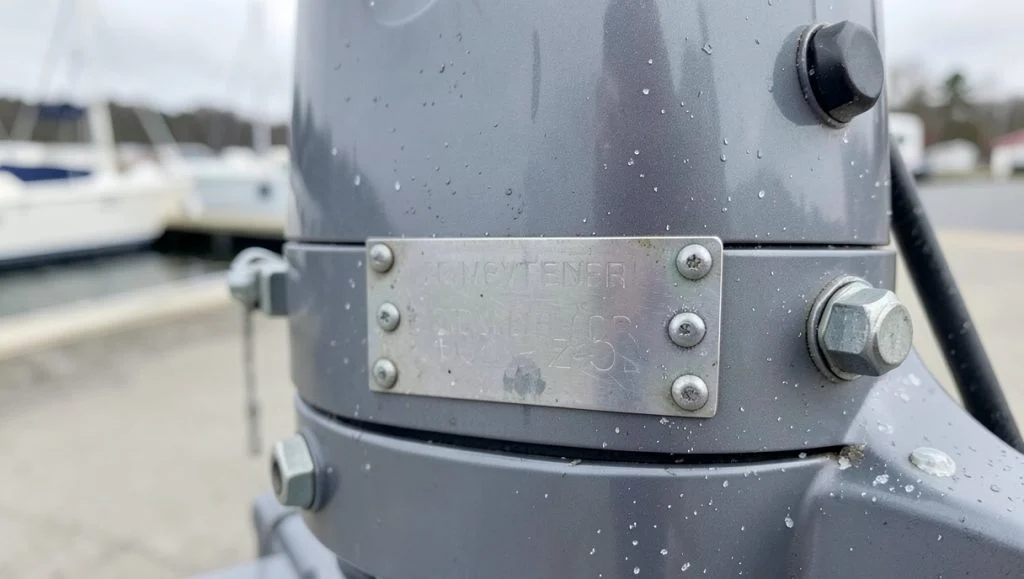
Suzuki has sold more than one generation of the DF150, and the DF150AP is the version in Suzuki’s current global lineup. Parts, software and fixes can differ between versions. Before you order parts or follow a repair guide, read the model code and serial number from the ID plate on the motor’s clamp bracket. Give both to your dealer so they match the right parts and service history.
Like any mechanical system, the DF150 has some issues that owners report. Below, I walk through the most common Suzuki DF150 problems, what usually causes them, and what to check first.
What are the most common problems with the Suzuki DF150?
The problems owners mention most are:
- Sudden shutoffs when you throttle up
- A primer bulb that needs pumping again and again
- Stalling or rough running at higher throttle from fuel restrictions
- Oil leaks and wiring complaints
- Overheating and corrosion, which affect any outboard used in salt or dirty water
1. Why does my Suzuki DF150 shut off when I throttle up?
Some owners report that the motor suddenly shuts off after a certain period of use, often in the mid-RPM range (one owner report puts it near 2,500 RPM). The motor may restart and idle fine, then shut off again after a few more starts. The most likely causes are weak battery power, loose or corroded connections, or fuel starvation.
Some owners on forums point to a poor connection at the white ECM wire. Suzuki has not confirmed this as a known fault, so treat it as one item to check, not a sure fix. A clean, tight connection and a healthy battery are worth checking first either way.
What to check, in order:
- Test the battery under load and charge or replace it if it is weak.
- Inspect the battery terminals. Use proper nuts, not wing nuts, and make sure the cables are clean and tight.
- Follow the main harness and check every plug for corrosion, looseness or chafing.
- Squeeze the primer bulb until firm to rule out fuel starvation, then start the engine.
- Check the fuel filter and water separator (see problem 3).
If the motor has sat for a while, tilt it up for some time and then lower it back into position before starting. If the shutoffs continue after these checks, it is often a rigging issue. Have a dealer connect diagnostic software to read the ECM’s stored fault codes.
2. Why does my DF150 primer bulb need frequent pumping?
A primer bulb that needs pumping during a run usually means fuel is not reaching the engine freely, or air is getting into the fuel line. Owners describe needing to pump it after very little use, sometimes every few minutes. The bulb may look fine from the outside and still be part of the problem.
Common causes include:
- Clogged fuel pick-up tube: Debris in the tank can block the pick-up. It is easy to miss during routine checks.
- Air leak: A loose hose clamp, cracked fitting or worn primer bulb can let air into the line.
- Blocked tank vent: If the tank cannot breathe, it builds a vacuum and fuel flow drops.
If the bulb will not re-inflate after you squeeze it, the pick-up or line is likely blocked. Try trolling for a while and retry. If it still does not re-inflate, there may be trash in the tube. Clearing it with proper suction can free the debris. Then run the motor until fuel flow picks up again. If the problem returns, replace worn hoses, clamps and the bulb.
3. Why does my DF150 stall at higher throttle?
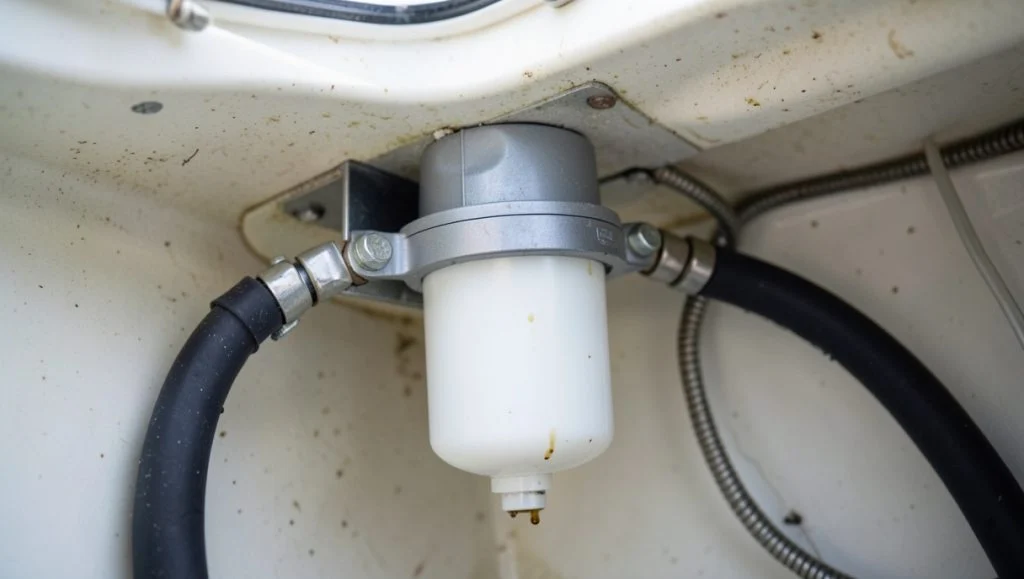
Stalling at higher throttle often points to a restricted fuel supply. A clogged fuel filter or water separator is a common cause, though not the only one. The fuel/water separator collects water and debris. If you do not replace it often enough, it fills up and restricts flow.
The typical pattern: the engine starts easily and runs well at low speed, around 3 or 4 mph. As you throttle up, it runs rough. If you hold higher throttle, it stalls. Even if you drop back to idle, it may still stall because it cannot get enough fuel. One owner described this on a motor with about 1,000 hours, mostly from trolling.
Replacing the fuel filter and water separator is the first thing to try. If the problem continues, check for water in the fuel, the pick-up tube and the fuel lines. After that, have a dealer test fuel pressure and the injectors.
4. Are Suzuki DF150 parts hard to find?
Some owners complain about waiting for parts, especially in areas with few Suzuki dealers. How easy parts are to get depends mostly on your local dealer network. Before you buy, find out how close your nearest authorized Suzuki dealer is and how quickly they can get common parts.
Some people say you never need to think about parts because the motor is strong enough. Don’t count on that. Any mechanical system can break, and when it does, you want parts and service close by. Suzuki’s US lineup is all four-stroke, from 2.5 to 350 hp, so the DF150 is a mainstream model in its range, not an orphan. Suzuki still sells some DT two-stroke models in certain markets outside the US, such as New Zealand and the Philippines.
5. Does the Suzuki DF150 leak oil or have wiring problems?
Some owners report oil leaks and wiring complaints, but neither is confirmed as a widespread DF150 defect. One forum user said she found oil leaking near the transom area a few months after buying her motor. Loose or poorly routed wiring can also cause sudden shutoffs, as covered in problem 1.
If you see oil under the cowling or near the transom, find the source before you run the motor again. Check the oil level, the oil filter seal, the drain plug and the oil pressure switch area. If the motor is under warranty, take it to a dealer instead of opening it yourself, so you do not risk the claim.
6. What causes overheating and corrosion on a DF150?
Overheating on any outboard usually comes from a worn water pump impeller, blocked water intakes or salt and scale buildup in the cooling passages. Corrosion is a risk for any motor used in salt water. These are not unique to the DF150, but they are common reasons outboards need repair.
- Check for a steady stream from the cooling water check port every time you start the motor.
- Flush the motor with fresh water after every saltwater trip.
- Inspect and replace sacrificial anodes when they are worn.
- Replace the water pump impeller on the schedule in your owner’s manual, or sooner if the water stream weakens.
What does the warning buzzer mean on a Suzuki outboard?
The warning buzzer and caution lamp mean the ECM has detected a condition that could damage the engine. Treat any buzzer as a signal to slow down and check the motor right away. The exact buzzer and lamp patterns, and what each one means, are listed in your DF150 owner’s manual.
When the buzzer sounds:
- Throttle back to idle right away.
- Check the cooling water stream from the check port.
- Check the oil level when it is safe to do so.
- Note the buzzer and lamp pattern and match it to the owner’s manual.
- If the warning does not clear, return to the dock at low speed and have a dealer read the fault codes.
Also check your full-throttle RPM. Suzuki rates the DF150AP for 5,000–6,000 rpm at wide-open throttle. If your motor runs well above or below that range, the propeller is likely the wrong pitch for your boat and load. Running outside the range can strain the engine.
How do you maintain a Suzuki DF150 to prevent problems?
Most DF150 problems above are tied to fuel, electrical connections and cooling. Regular maintenance prevents many of them. Follow the exact intervals in your owner’s manual, because they depend on the model version and how you use the motor.
| Item | What to do | Why it matters |
|---|---|---|
| Engine oil and oil filter | Change on the owner’s manual schedule | Protects the engine and helps you spot leaks early |
| Fuel filter and water separator | Replace on schedule, sooner with poor fuel | Prevents stalling and rough running at throttle |
| Water pump impeller | Inspect and replace on schedule | Prevents overheating |
| Spark plugs | Inspect and replace on schedule | Keeps starting and idle smooth |
| Timing chain | Have a dealer inspect it at the interval in the manual | Catches wear before it causes major damage |
| Battery and wiring | Clean and tighten connections each season | Prevents sudden shutoffs |
| Anodes and flushing | Flush after salt use, replace worn anodes | Limits corrosion |
How often should I change the oil and water pump impeller?
Use the hour-based or time-based intervals in your DF150 owner’s manual, whichever comes first. Heavy use, salt water, and lots of idling or trolling are reasons to service sooner. Keep receipts and a written log, because they help with warranty claims and resale.
Does the Suzuki warranty cover these problems?
Warranty coverage depends on the model year, where you bought the motor and whether it was sold for recreational or commercial use. Defects in materials or workmanship are what warranties typically cover. Problems caused by bad fuel, skipped maintenance or poor rigging usually are not.
- Read the warranty statement that came with your motor, or ask your dealer for it.
- Have warranty work done by an authorized Suzuki dealer.
- Ask the dealer to run your serial number for any open service bulletins or recalls. These can fix known issues at no cost.
- Keep maintenance records to show the motor was cared for.
Should you fix a DF150 yourself or use a dealer?
Simple maintenance is often DIY-friendly. Diagnosis and engine work are usually dealer jobs. Repair costs vary a lot by region, shop rates and parts prices, so get a written quote before any major job.
| Usually DIY | Usually dealer |
|---|---|
| Cleaning and tightening battery connections | Reading ECM fault codes |
| Replacing fuel filters and water separator | Fuel pressure and injector testing |
| Replacing primer bulb, hoses and clamps | Timing chain inspection |
| Flushing and replacing anodes | Oil leaks from internal seals |
| Oil and filter changes (out of warranty) | Any work on a motor still under warranty |
How many hours will a Suzuki DF150 last?
There is no fixed number. A DF150’s lifespan depends mostly on maintenance, cooling system care, fuel quality and how hard it runs. A high-hour motor with full service records can be a better buy than a low-hour motor that sat neglected. Look at the service history, not just the hour meter.
Is the Suzuki DF150 a reliable outboard?
The DF150 is a widely used outboard, and many of the problems owners report trace back to fuel, wiring and maintenance rather than core engine design. That said, reliability depends heavily on care and on having good dealer support nearby. A well-maintained DF150 with a dealer close by is a reasonable choice. A neglected one, far from service, is a risk with any brand.
What should you check before buying a used Suzuki DF150?
- Read the model code and serial number from the ID plate and confirm the version.
- Ask for maintenance records, including oil, filters, impeller and spark plugs.
- Have a dealer read the engine hours and stored fault codes.
- Ask the dealer to check for open service bulletins or recalls.
- Look under the cowling for oil, corrosion and damaged or loose wiring.
- Start the motor and confirm a strong cooling water stream.
- Sea trial it and confirm it reaches the 5,000–6,000 rpm full-throttle range without stalling or warnings.
- Consider paying for a compression test before you buy.
Which is better, the Suzuki DF150 or the Yamaha F150?
Neither is better for everyone. The Suzuki DF150, Yamaha F150 and Mercury 150 FourStroke are all 150 hp four-strokes aimed at similar boats. The right pick usually comes down to dealer support, rigging and price where you live.
- Dealer support: Choose the brand with a strong authorized dealer near where you keep the boat. This matters more than small spec differences.
- Weight: Compare official dry weights for the shaft length you need, since transom weight affects how the boat sits and planes.
- Rotation and twin rigs: If you need counter-rotation for twin engines, check what each brand requires. On the DF150AP it takes an optional connector and a counter-rotation prop.
- Controls and gauges: If you are repowering, check whether your existing controls work with the new motor or must be replaced.
- Warranty and price: Compare current written warranty terms and installed price quotes from local dealers.
General Pros and Cons of the Suzuki DF150:
Pros
- Strong torque and acceleration from the 2,867 cm³ powerhead
- It is compact and lightweight for its power class
- Multi-stage induction system
- Multi-point sequential fuel injection
- Lean Burn Control System for better fuel economy
Cons
- Parts and service can be slow in areas with few Suzuki dealers
- Some owners report wiring-related shutoffs and oil leaks
- Fuel filters, water separator, oil and filter need regular changes to avoid stalling and other problems
Final Verdict
Suzuki is a well-known brand, but no outboard is free of problems. Most DF150 complaints involve fuel delivery, battery and wiring connections, and skipped maintenance, and most of those can be prevented or fixed without major engine work. Before you buy, talk to your local dealer about proper use, maintenance and parts availability. Follow the owner’s manual schedule, keep records, and let a dealer handle diagnosis and warranty work. That way, if something does go wrong, you can get it fixed quickly.
Related Posts:
- What Are the Common Volvo Penta Duo Prop Problems?
- Most Common Problems With Verado 275 Outboard
- Most Common Problem With King Cobra Outdrive
- Most Common Problems with Mercury Verado 250
- Most Common Problems with Mercury Optimax 150
Frequently Asked Questions About the Suzuki DF150
What full-throttle RPM should a Suzuki DF150 reach?
Suzuki rates the DF150AP for 5,000–6,000 rpm at wide-open throttle. If your motor runs well above or below that range, the propeller is likely the wrong pitch for your boat and load. Running outside the range can strain the engine, so check RPM during a sea trial and adjust the prop if needed.
Where is the serial number on a Suzuki DF150?
The model code and serial number are printed on the ID plate on the motor’s clamp bracket. Read both before you order parts or follow a repair guide, because parts, software and fixes can differ between DF150 versions. Give both numbers to your dealer so they can match the right parts and service history.
Can a Suzuki DF150 run in counter-rotation?
Yes. Selective Rotation is available on the DF150AP, so it can run in counter-rotation for twin-engine rigs. You need an optional connector and a counter-rotation propeller to do it. If you are comparing brands for a twin setup, check what each motor requires before you buy.
Can I change the oil on my Suzuki DF150 myself?
Yes, oil and filter changes are usually DIY-friendly once the motor is out of warranty. If the motor is still under warranty, have an authorized Suzuki dealer do the work so you do not risk a claim. Either way, follow the owner’s manual interval and keep receipts and a written service log.
Does Suzuki still make two-stroke outboards?
Not in the US. Suzuki’s US lineup is all four-stroke, from 2.5 to 350 hp, and its focus has been on four-strokes since it launched the DF9.9 and DF15 in 1994. Suzuki still sells some DT two-stroke models in certain markets outside the US, such as New Zealand and the Philippines.
