
Quick answer: The most common Verado 275 problems reported by owners are lower unit (gearcase) leaks and gear wear, hard starting or no-start, ignition coil failures that cause misfires and low RPM, fuel pump faults, and oil leaks from seals. The Verado 275 is an older supercharged inline-six, so careful maintenance matters more than ever.
Previously people used to view outboard engines in a different way. However, those assumptions changed when Mercury came out with its Verado engines. These fast, powerful supercharged outboards changed how many boaters thought about big four-stroke power.
From Mercury, the Verado series offers a smooth, strong experience. The Verado 275 pairs a supercharged inline-six with a robust design. The “class-leading displacement” Mercury talks about today belongs to the newer 4.6L V8 Verado, not the 2.6L Verado 275.
However, nothing is perfect. The Verado 275 is a great engine, but it has some shortcomings as well. In this article, we will discuss the most common problems you might run into with the Verado 275 outboard, how to troubleshoot them, and what you can do to prevent them. Let’s dive in.
What Is the Mercury Verado 275?
The Verado 275 is a supercharged, intercooled 2.6L (158.5 cu in) inline-six four-stroke outboard. Mercury built this L6 Verado from the mid-2000s. In 2018, Mercury replaced the L6 Verado at its horsepower ratings with the 4.6L V8 Verado, which comes in 250 and 300 hp (Trade Only Today).
Mercury’s current Verado lineup (V8 250/300, V10 350/400 and V12 600) has no 275 hp model. In December 2022, Boating Magazine reported that the V10 Verado marked the retirement of the 19-year-old supercharged 2.6L inline-six platform. If you own a Verado 275 today, you own an older, discontinued engine generation.
What years did Mercury make the Verado 275?
The Verado 275 belongs to the L6 Verado family that Mercury built from the mid-2000s. Mercury’s own service paperwork lists 2005–2006 engines as Gen I L6 Verados. The L6 was replaced at the 250 and 300 hp ratings by the V8 Verado in 2018. To confirm your engine’s exact model year, check the serial number tag on the engine and ask a Mercury dealer to look it up.
What are the official Verado 275 specs?
These figures come from the Verado 200/225/250/275 service manual:
| Spec | Verado 275 (L6) |
|---|---|
| Engine type | Supercharged, intercooled inline six, four-stroke |
| Displacement | 2.6L (158.5 cu in) |
| Cylinders | 6 (one ignition coil per cylinder) |
| Gear ratio | 1.85:1 |
| Idle speed | 550 ± 50 RPM |
| Wide-open-throttle range | 5,800–6,400 RPM |
| Weight | About 645–677 lb, depending on shaft length (20 to 30 in). Some Mercury spec sheets list 635 lb dry. |
Is the Verado 275 supercharged? Yes. It uses a supercharger and an intercooler on its 2.6L inline-six.
What is the full-throttle RPM range? 5,800–6,400 RPM. If your engine can’t reach that range at wide-open throttle, look at propeller pitch, boat load and the problems below, such as a failed coil or a fuel supply fault.
What Are The Common Verado 275 Outboard Problems?
Mercury built the Verado 275 to deliver strong, smooth performance. Its supercharged inline-six gave boaters a lot of power in a quiet four-stroke package.
Besides, the four-stroke design and fuel economy are something you can’t ignore. Much of the Verado 275’s popularity comes from its engine performance.
However, along with that performance, the Verado 275 does come with some drawbacks. Let’s go ahead and learn about them.
1. Regular Lower Unit Issues
A common complaint with Verados is the lower unit (gearcase). Owners have reported it on earlier models, and it shows up on the Verado 275 as well. After enough use, the lower unit can fail.
According to one user, his lower unit stopped working after 900 miles. He was fortunate to discover the problem in the shop. Otherwise, he could have been stranded.
Some users also reported leaks in the lower unit, mostly at high hours. A leaking seal can let water into the gear lube. When you drain or check the gear lube, look for milky or watery oil. That is a sign water is getting in.
Aside from these issues, the lower unit gears may also not be aligned correctly. As a result, you might hear loud clicking or grinding. This causes the gears to wear out much faster, and metal shavings and chips build up throughout the unit.
Change the gear lube on the schedule in your owner’s manual and inspect what comes out. Metal flakes, a burnt smell or milky oil all mean it is time for a certified technician. Catching these signs early is usually much cheaper than replacing a failed gearcase.
2. Engine won’t Start
Another problem with the Mercury Verado 275 is starting. Sometimes the engine is hard to start, and other times it will not start at all.
A broken internal part can cause this. Another possibility is that something is blocking enough air from getting into the engine.
A low-voltage battery is another common cause. If the battery cannot provide enough power, the engine can’t crank or run its electronics. Replacing a weak battery often fixes this.
One user reported that his Verado 275 wouldn’t fire at all. The problem continued even after he checked all the fuses and the fuel. The cause, found later, was the ignition not sparking the plugs.
As a precaution, check the battery’s health and make sure the fuses are in good shape. It is also a good idea to test the spark plugs.
3. Failure of the Pencil Coils
Owners also report ignition coil trouble on the Verado 275. The engine uses one coil per cylinder. A failed coil can cause misfires and low RPM even when the rest of the engine is working fine.
According to one user, his friend’s engine had this issue. The engine wouldn’t reach 5,000 RPM even after all the plugs were cleaned and the fuel filters changed. A second user reported the same problem, but his wouldn’t go over 3,000 RPM.
A failed coil can cause this kind of problem. Because the Verado 275 has six cylinders and one coil per cylinder, one bad coil makes the engine misfire and run on five cylinders. More failed coils mean more dead cylinders. Replacing a coil is a fairly straightforward job. The harder part is finding the right quality part.
Another problem can be fuel pump failure. The engine has two fuel pumps, and one or both can fail. When that happens, the engine may stop running. Imagine that happening far from shore!
Mercury addressed one fuel system part with a service recommendation. In November 2008, Mercury recommended replacing the fuel supply module float switch on 200/225/250/275 Verado L6 engines from model years 2005–2006 (Gen I, serial 1B517433 and below), per this Mercury service document. If you own an early engine, ask a Mercury dealer whether that work was done.
4. Leaking Oil from the Pump
Oil leaks are a common complaint across the Verado lineup, and the Verado 275 is no exception. Spilled oil can also make a big mess.
A leaking seal is usually the cause. The Verado 275 has several seals on the drive shaft. They work well when new, but they can start to leak with age. A leak may be another reason your engine isn’t making full power.
Fixing this problem can be a real hassle. Corrosion builds up around the seal area, which can make the lower unit hard to remove. In salt water, that buildup happens much faster.
Regular service is the best way to prevent leaks. Catching a weeping seal early saves you from a bigger, messier repair later.
5. What other Verado systems should you watch?
The Verado 275 has parts many simpler outboards don’t, such as the supercharger and, on many rigs, power-assisted steering. Power trim is another system that gets heavy use. When the engine is serviced, ask the technician to inspect these systems too. Pay attention to new whining noises, a stiff or loose steering feel, or trim that creeps or won’t hold.
How Do You Troubleshoot a Verado 275 That Won’t Run Right?
Work from the simple checks to the complex ones. Stop and call a Mercury-certified technician if a step needs tools or skills you don’t have.
What should you check when the engine won’t start?
- Make sure the engine is in neutral and the lanyard (kill switch) is attached.
- Check battery voltage and clean, tighten and inspect the battery cables.
- Check all fuses and relays.
- Confirm you have fuel, the tank vent is open, and the fuel line and filter are not blocked.
- Look for fault messages on your SmartCraft gauge or VesselView display.
- Test the spark plugs and coils for spark.
- If it still won’t start, have a dealer scan the engine with Mercury’s diagnostic tool.
What should you check when the engine won’t reach full RPM?
- Compare your wide-open-throttle RPM to the 5,800–6,400 RPM range.
- Check for warning messages or a power-reduction alert on the display.
- Inspect the propeller for damage and confirm the pitch suits your boat and load.
- Replace fuel filters and check for water in the fuel.
- Check spark plugs and coils. One failed coil leaves the engine on five cylinders.
- Have a technician check fuel pressure and both fuel pumps.
Why does my Verado go into Guardian mode?
Guardian is Mercury’s engine protection system. It cuts engine power when it detects a condition that could damage the engine, such as overheating or a problem with oil, fuel or a sensor. Guardian mode is a warning, not the problem itself. Slow down, check the display for the fault message, and check that water is flowing from the tell-tale. Then have the fault code read before you run hard again.
What should you do about a fuel pump or lift pump warning?
A fuel pump warning points to the fuel supply side. Start with the basics: fuel level, tank vent, fuel line kinks, the primer bulb and the water-separating fuel filter. If the warning comes back, a dealer should test the pumps and the fuel supply module. On 2005–2006 Gen I engines, also confirm the float switch service recommendation above was completed.
How do you read Mercury fault codes?
Verado engines report faults through Mercury’s SmartCraft system. If your boat has SmartCraft gauges or a VesselView display, check them for active alarms and fault messages. Write down the exact message. A Mercury dealer can connect a diagnostic tool to read stored codes and engine history in more detail.
How Do You Prevent Verado 275 Problems?
Most of the problems above get worse with skipped maintenance. Follow the intervals in your Verado owner’s manual or ask your dealer for the schedule for your serial number. Key items include:
- Engine oil and filter: The Verado 275 is a four-stroke with a crankcase oil system. It needs regular oil and filter changes.
- Gear lube: Change it and inspect it for water or metal each time.
- Spark plugs and coils: Replace plugs on schedule and check coil boots and connections.
- Water pump impeller: A worn impeller can lead to overheating and Guardian mode.
- Anodes: Replace them when they are worn, especially in salt water.
- Fuel filters: Replace them and drain water from the separator.
How should you flush the engine after salt water?
- Flush the engine with fresh water after every saltwater trip, using the method in your owner’s manual.
- Rinse the outside of the engine, the lower unit and the trim area with fresh water.
- Trim the engine down after flushing so water drains out.
- Check anodes and look for white powder or bubbling paint, which signal corrosion.
- Keep a light coat of a marine corrosion protectant on exposed metal under the cowl.
Is the Mercury Verado 275 a Reliable Outboard?
A well-maintained Verado 275 can be a dependable engine, but it is now an older, discontinued design. The problems in this article are the ones owners report most. Most can be caught early with regular service.
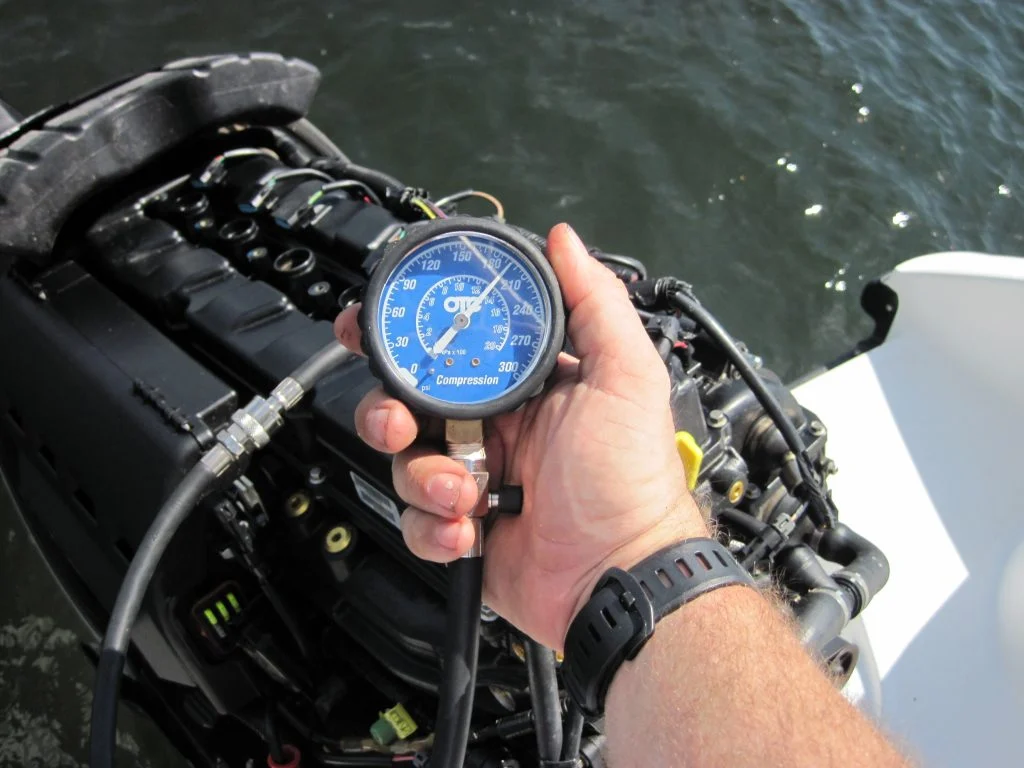
How many hours does a Verado 275 last? Mercury does not publish a set lifespan in hours. Engine life depends on how it was maintained, how hard it was run, and whether it lived in salt or fresh water. If you are buying a used one, ask for service records and have a technician run a compression test and pull the SmartCraft engine history.
Should You Repair or Repower a Verado 275?
Use these decision rules:
- Repair if the powerhead is healthy (good compression, clean history) and the fault is a part like a coil, fuel pump, seal or battery.
- Get a repower quote if the powerhead or supercharger is failing, or several major systems need work at once.
- Think about parts. The L6 platform is retired, so ask your dealer how easy it is to get the parts you may need.
- Compare options. Mercury’s current replacements at this power level are the V8 Verado 250 and 300. It is also worth getting quotes from Yamaha and Suzuki dealers for 250–300 hp outboards, and asking each about rigging, controls and gauge compatibility with your boat.
What Should You Do If the Engine Fails Offshore?
- Make sure everyone is wearing a life jacket.
- Drop anchor if the depth allows, to keep from drifting into danger.
- Check the display for fault messages and try the simple fixes: lanyard, fuel, battery, fuses.
- Call for help on VHF channel 16 if anyone is in danger, or contact a towing service if you are not.
- Before every trip, leave a float plan with someone on shore and carry required safety gear.
Pros and Cons of Verado 275 Outboard:
Mercury’s Verado line was a milestone for the brand. It brought supercharged four-stroke power to outboard boaters.
These engines do have some excellent pros, despite the drawbacks above. For many owners, the pros outweigh the cons, as long as the engine is well maintained.
Pros
- Although this engine makes a lot of power, it can be economical to run. Mercury designed the Verado to reduce windage, the friction caused by oil being thrown around inside the engine, which helps efficiency.
- This is a four-stroke engine, which comes with several benefits, fuel economy being one. Like any four-stroke, it still needs regular engine oil and filter changes, and its gearcase needs gear lube. Besides, it is more environmentally friendly.
- This engine has a straight-six (inline-six) cylinder layout with a supercharger and intercooler. The inline-six design is known for running smoothly. Keep in mind that the L6 platform is now discontinued, so plan ahead for parts and service.
Cons
- Regular Lower Unit Issues
- Engine won’t Start
- Failure of the Pencil Coils
- Leaking Oil from the Pump
Conclusion
Weigh both the pros and cons of the Verado 275 outboard before buying a used one or putting money into repairs. The engine is powerful despite its shortcomings, and it comes from a brand with a long history in outboards.
A Verado 275 with good service records and a healthy powerhead can still be a strong, useful engine. Stay on top of gear lube, coils, fuel filters and saltwater flushing, and it is far less likely to leave you disappointed.
Related Posts:
- Most Common Suzuki DF150 Outboard Problems
- Most Common Problem With King Cobra Outdrive
- Most Common Problems with Mercury Verado 250
- Most Common Problems with Mercury Optimax 150
- Most Common Problems with Mercury Optimax 225
Frequently Asked Questions About the Verado 275
How many hours does a Mercury Verado 275 last?
Mercury does not publish a set lifespan in hours for the Verado 275. Engine life depends on how it was maintained, how hard it was run, and whether it was used in salt or fresh water. If you are buying a used one, ask for service records, a compression test and the SmartCraft engine history.
What is the full throttle RPM range for a Verado 275?
The Verado 275’s full-throttle (wide-open-throttle) range is 5,800–6,400 RPM, according to the service manual. Idle speed is 550 ± 50 RPM. If the engine can’t reach the full-throttle range, check propeller pitch and boat load first. Then look for a failed ignition coil or a fuel supply fault.
How much does a Mercury Verado 275 weigh?
The Verado 275 weighs about 645–677 lb. The exact weight depends on shaft length, which runs from 20 to 30 inches. Some Mercury spec sheets list 635 lb dry. Check your engine’s shaft length to find the closest figure, and confirm it with your owner’s manual or a Mercury dealer.
Is the Verado 275 supercharged?
Yes. The Verado 275 is a supercharged, intercooled 2.6L (158.5 cu in) inline-six four-stroke outboard. The supercharger is one of the parts many simpler outboards don’t have. Ask your technician to inspect it during routine service, and pay attention to any new whining noise from the engine.
Does Mercury still make the Verado 275?
No. In 2018, Mercury replaced the inline-six Verado at its horsepower ratings with the 4.6L V8 Verado, which comes in 250 and 300 hp. Mercury’s current Verado lineup has no 275 hp model. If you own a Verado 275, plan ahead for parts and service, because the platform is discontinued.
