Quick answer: The three most common Yamaha 115 four-stroke problems are a starter that won’t engage or turn over, an engine that struggles to start, and unusual vibration or noise. Most trace back to a blown fuse, a weak battery, fuel or spark plug trouble, or a damaged prop or loose part. Many are simple DIY fixes. Others need a Yamaha dealer.
The Yamaha 115 4 stroke outboard delivers strong performance, reliability, and power.
It is an excellent choice for fishing boats, but it still has some common issues that many owners run into.
In this article, I will walk you through the most common problems you might face with the Yamaha 115 4 stroke motor, and how to fix them. You will also find key specs, warning signs, maintenance tips, and clear rules on when to call a dealer.
| Problems | Reasons |
| Starter Does Not Engage Or Turn Over | Faulty or damaged electric system caused by blown fuseDamaged or dead battery |
| Engine Struggles During Starting | Low fuel level or existing leakage inside the fuel tankExcess engine oilCracked or burned Spark plugs |
| Unusual Vibration Or Noises | Damaged parts of the propeller system or bad propellerLoose connection |
What Are the Key Specs of the Yamaha F115?
Knowing your engine’s basic specs helps you buy the right parts and fluids. These figures are for the current Yamaha F115, from Yamaha’s official F115 page. Older F115 generations may differ, so always confirm with the owner’s manual for your model year.
| Spec | Current Yamaha F115 |
| Engine type | Inline four-cylinder, dual overhead cams (DOHC) |
| Displacement | 1.8L |
| Valves | 4 per cylinder |
| Weight | 377–386 lb (171–175 kg), depending on shaft length, without oil or prop |
| Alternator output | 35 amps |
| Full-throttle range | 5300–6300 rpm |
| Recommended fuel | 87 octane, no more than 10% ethanol (E10) |
| Recommended oil | Yamalube 4M (see owner’s manual) |
| Flushing | Freshwater flush device (no need to run the engine) |
| Warranty | 3-year limited (pleasure use), 1-year limited (commercial use) |
How much does a Yamaha F115 weigh? The current F115 weighs 377–386 lb (171–175 kg), depending on shaft length. That figure does not include oil or the prop.
What oil does a Yamaha F115 take? Yamaha recommends Yamalube 4M engine oil. Oil capacity varies by model and whether you change the filter, so use the exact amount listed in your owner’s manual.
3 Common Yamaha 115 4 Stroke Problems:
These three problems can show up on both older and newer F115 engines. Most of them are not unique to Yamaha. They are typical for any aging or poorly maintained outboard.
1. Why Won’t the Starter Engage or Turn Over?
The first common trouble most owners mention with the Yamaha 115 4 stroke engine is starter failure.
Yamaha 115 4 stroke users often say the starter does not engage properly or fails to turn over. Some users also point out that the motor struggles to crank.
This problem can come from a faulty electric system or a blown fuse. It can also be caused by a damaged or weak battery.
Therefore, to confirm the core reason, you need to do a thorough check.
Check the Simple Things First: Kill Switch and Neutral
Before you open anything, rule out the two safety switches that stop many engines from starting:
- Kill switch lanyard: Make sure the lanyard clip is fully seated in the kill switch. If it is loose or missing, the engine will not start.
- Neutral safety switch: The engine is designed to start only in neutral. Move the control lever firmly into neutral and try again.
- Battery switch: If your boat has a battery selector switch, make sure it is on.
Possible Fix
If the safety switches are fine, follow these steps to find the cause.
This problem may come from a faulty electric system caused by a blown fuse…
Therefore, the first task is checking the main fuse of your Yamaha 115 motor to see whether it is okay or blown.
You can start the inspection by unscrewing all the connectors to remove the main electric cover. Then, remove the fuse holder using a pair of pliers.
Now, you have a clear view to check whether the center connection of the fuse is damaged. If it is cracked or broken, replace the fuse with a new one.
Use your outboard service manual to find the correct fuse amperage for your model. Never use a higher-amp fuse than specified. It can let wiring overheat and cause a fire.
A damaged or dead battery can also cause this trouble…
To check the battery condition, safely disconnect the negative cable first. Then, disconnect the positive cable and remove the battery from the housing.
If the battery is damaged, replace it. If it does not seem broken, charge it fully before re-installing it.
You should also check the battery terminals for debris or corrosion. Use a wire bristle brush to remove it.
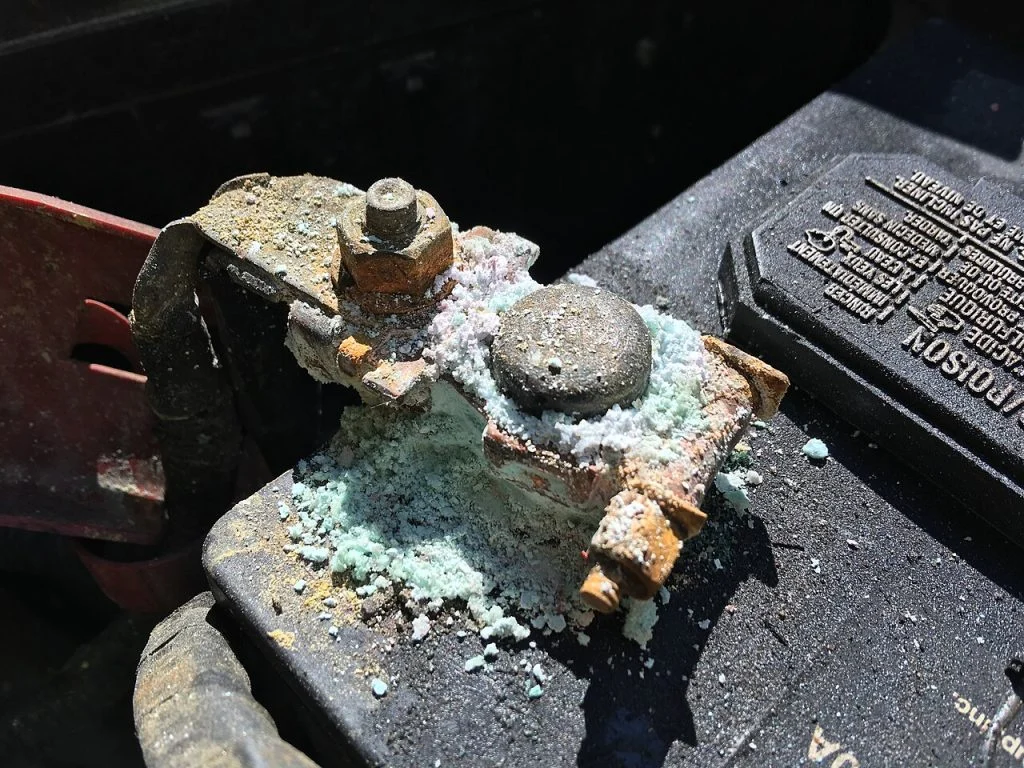
Remember to take your time to clean all the built-up corrosion. You can either use a debris cleaning solution or baking soda and water mixture to clean.
Also, do not forget to dry all the terminals with a towel after cleaning.
When you reinstall the battery, connect the positive cable first and the negative cable last.
2. Why Does the Engine Struggle to Start?
Another common problem with the Yamaha 115 outboard is an engine that struggles to start.
Technically speaking, this is not an issue you will only encounter with the Yamaha 115 4 stroke outboard or boat motor.
Still, users often say their Yamaha 115 gradually stops running as smoothly as usual, and it visibly struggles when they try to start it.
Honestly, this happens with almost all engines, especially when the motor gets old or does not get regular scheduled servicing.
Possible Fix
Let’s look at the likely causes and how to fix them.
It can occur because of a low fuel level or a leak in the fuel tank…
If that is the case, first check your outboard fuel system. If the tank is low, refill it.
While refilling your fuel tank, make sure you are filling it with the correct fuel type. For the F115, Yamaha recommends 87-octane fuel with no more than 10% ethanol.
Next, inspect the fuel system for leaks. Start with the fuel lines that connect the tank to your outboard motor.
As soon as you find any leaks or breaks, stop your outboard motor. Then contact a qualified mechanic to fix the fuel system.
Water or dirt in the fuel can also cause hard starting…
Ethanol-blended fuel can absorb water, and old fuel can leave deposits. Yamaha recommends an external Yamaha 10-micron fuel/water separating filter for the F115. Check that filter for water and replace it if it looks dirty. If the engine still runs rough, small fuel passages such as the fuel pump filter or vapor separator tank may be clogged. That job is best left to a dealer.
Excess engine oil can cause your outboard engine to run poorly…
Therefore, check the oil level. First, remove the filler cap and dipstick. Then, wipe the dipstick with a clean towel and reinsert it.
Now check the oil level mark on the dipstick, if the mark is indicating above “H”, that means you must remove the excess oil.
But if it indicates below “L”, you need to refill the engine oil.
Another possible reason is cracked or burned spark plugs…
To check the spark plugs, use a spark plug wrench to remove them safely. If they look damaged or burned, replace them with new ones.
Before installing new plugs, measure and set the spark plug gap.
Also, cross-check the spark plug model and gap with your outboard owner’s manual.
3. What Causes Unusual Vibration or Noise?
Another familiar issue with the Yamaha 115 4 stroke outboard is unusual vibration or noise coming from the motor.
Users have experienced that their engine suddenly makes excessive vibrating sounds.
It can happen with other outboard or boat motors too. This problem is more likely when the motor gets older and misses regular maintenance.
Still, it helps to know the likely causes and the easy fixes.
So, let’s learn the details together.
Possible Fix
A bad propeller or any damaged parts of the propeller system can cause excessive noise and vibration.
The first task is to inspect the entire propeller system whenever you notice excessive noise from your Yamaha 115 motor. Tilt the engine up and remove the kill switch lanyard before you touch the prop.
If you notice any damage, leak, or cracks while checking, you should remove the part and replace it.
Next, check the condition of the propeller shaft. If you notice any cracks, bends, or leaks there, repair or replace it.
You also need to inspect whether any seaweed or other detritus is stuck or entangled in there. If so, then clean and remove all build-up debris from there.
Loose connections can cause such noises…
Therefore, thoroughly check all the connectors, bolts, screws, and terminals that are connected directly with the engine.
Tighten the connections, if needed, and again try to start your engine to check.
What Other Problems Should You Watch For?
Beyond the big three, a few general outboard issues can affect any F115, especially older engines or engines used in salt water.
Overheating
Overheating usually means the cooling system is not moving enough water. Common causes on outboards include a blocked water intake, a worn water pump impeller, or a stuck thermostat. A weak or missing telltale (the small stream of water from the engine) is an early sign. Stop the engine and check before you keep running.
Corrosion
Salt, brackish, and polluted water speed up corrosion. The F115 has a freshwater flush device, so you can flush the cooling passages without starting the engine. Flushing after each saltwater trip helps keep salt from building up.
Why Is My Yamaha 115 Beeping?
A beeping alarm is the engine’s warning system telling you something is wrong. On Yamaha four-strokes, alarms commonly point to overheating or low oil pressure. Your gauge or display may also show a warning light or code.
If you hear a warning alarm:
- Throttle back and shift to neutral.
- Check the telltale stream and the oil level.
- Look up the alarm pattern or code in your owner’s manual. Patterns vary by model and gauge type.
- If you can’t find and fix the cause, return slowly to the dock and see a Yamaha dealer.
Do not ignore a warning alarm. Running an engine that is overheating or low on oil pressure can cause serious damage.
How Do You Prevent Yamaha 115 Problems?
Regular maintenance prevents most of the problems in this article. Follow the hour-based and annual service intervals in your owner’s manual. Then add these habits:
- Use the right fuel: 87 octane with no more than 10% ethanol.
- Filter your fuel: Run an external Yamaha 10-micron fuel/water separating filter and replace it on schedule.
- Use the right oil: Yamalube 4M, filled to the level shown on the dipstick.
- Flush after salt water: Use the built-in freshwater flush device.
- Watch the telltale: Check for a steady stream every time you start the engine.
- Keep the battery charged: Clean the terminals and check the cables often.
- Keep records: Save service receipts. They help with warranty claims and resale.
How Many Hours Will a Yamaha 115 Four-Stroke Last?
There is no fixed number. Engine life depends mostly on maintenance, how hard the engine is run, and whether it is used in fresh or salt water. An F115 that gets the right fuel, oil, flushing, and scheduled service will last far longer than one that is neglected. When buying a used engine, service records matter more than the hour meter alone.
Should You Fix It Yourself or See a Yamaha Dealer?
Use these simple rules to decide.
Usually safe to do yourself:
- Checking the kill switch lanyard, neutral position, and battery switch
- Charging the battery and cleaning terminals
- Replacing a blown fuse with the correct amperage
- Checking oil level and changing spark plugs
- Changing the external fuel/water separating filter
- Clearing weeds or fishing line from the prop
See a Yamaha dealer when:
- A fuse keeps blowing after you replace it
- You find a fuel leak you can’t fix by tightening a fitting
- An overheat or low-oil-pressure alarm keeps coming back
- The engine needs work inside the fuel pump, vapor separator, or water pump
- The prop shaft is bent or the lower unit leaks
- The engine is still under warranty and the repair is major
The F115 comes with a 3-year limited warranty for pleasure use and a 1-year limited warranty for commercial use. If your engine is still covered, talk to a dealer before starting a big repair.
What Safety Steps Should You Follow Before Working on the Engine?
- Disconnect the battery (negative cable first) before working on electrical parts or near the starter.
- Remove the kill switch lanyard so the engine can’t start by accident.
- Work in a well-ventilated area when handling fuel. Gas vapors can build up and ignite.
- Keep sparks and flames away from fuel lines, filters, and the battery. No smoking.
- Wipe up spilled fuel right away and dispose of rags safely.
- Keep a fire extinguisher within reach.
Is the Yamaha 115 4 Stroke a Reliable Outboard?
Yes. Yamaha’s four-stroke lineup has a strong reputation, and the F115 is known for reliability, good fuel economy, and quiet operation. Most of the common problems above come from batteries, fuel, spark plugs, or the prop, not from a basic design flaw.
What Is the Top Speed of a Yamaha 115 Four-Stroke?
Yamaha does not publish a top speed for the standard F115. Top speed depends on your boat, the load, and the prop. You may see “nearly 51 mph” online, but Yamaha uses that figure for the V MAX SHO 115, a separate high-performance model that Yamaha calls its fastest 115-hp four-stroke. For a realistic number, check Yamaha’s performance bulletins for a hull like yours.
For help with problems or repairs, Yamaha provides after-sale customer service through its dealer network.
Final Thoughts:
Yamaha is one of the legendary industry leaders in blending innovation with technology, especially for outboard and boat engine production.
At 377–386 lb, the F115 is not a light engine, so make sure it suits your boat. In return, you get reliability, good fuel economy, quiet operation, and solid power.
Many of the common problems with this Yamaha motor are simple to fix at home. For fuel system, cooling, or lower unit repairs, or anything still under warranty, let a Yamaha dealer handle it.
You Can Also Read:
Frequently Asked Questions
Why won’t my Yamaha 115 outboard start?
Most no-start problems on a Yamaha 115 have simple causes. Check that the kill switch lanyard is fully seated, the shift lever is in neutral, and the battery switch is on. Next, check the main fuse and the battery charge. If the engine cranks but won’t fire, check the fuel level, fuel filter, and spark plugs.
How much does a Yamaha F115 weigh?
The current Yamaha F115 weighs 377–386 lb (171–175 kg), depending on shaft length. That figure does not include engine oil or the propeller. Older F115 generations may differ, so check the owner’s manual for your model year. Because it is not a light engine, make sure it suits your boat before you buy.
What oil does a Yamaha F115 take?
Yamaha recommends Yamalube 4M engine oil for the F115. The exact amount depends on your model and whether you also change the oil filter, so use the capacity listed in your owner’s manual. After filling, check the dipstick. The level should sit between the "L" and "H" marks and never above "H".
What fuel does a Yamaha F115 use?
The Yamaha F115 runs on 87-octane gasoline with no more than 10% ethanol (E10). Yamaha also recommends an external Yamaha 10-micron fuel/water separating filter. Ethanol-blended fuel can absorb water, so check that filter for water and replace it if it looks dirty or is due on your service schedule.
What warranty comes with the Yamaha F115?
The current Yamaha F115 comes with a 3-year limited warranty for pleasure use and a 1-year limited warranty for commercial use. If your engine is still covered, talk to a Yamaha dealer before you start a major repair. Keep your service receipts, because they help with warranty claims and resale.