
Quick answer: Mercury High-Performance Gear Lube and Quicksilver High Performance Gear Lube are the same SAE 90 oil sold under two labels. Quicksilver is Mercury Marine’s own parts and accessories brand, not a rival company. Mercury lists this grade for production outboards and sterndrives of 75 HP and up. For outboards under 75 HP, Mercury lists Premium 80W-90.
Many new boaters get confused by the Mercury High-Performance Gear Lube vs. Quicksilver question. Both names are well known in the outboard world. Many boaters don’t realize the two oils are the same product.
Quicksilver is not a separate company. It is Mercury Marine’s own brand of aftermarket parts, oils and accessories. It is sold through Mercury dealers and retail stores. When Mercury sells the exact same oil under its own name, it is called Mercury High-Performance Gear Lube.
So, let’s figure out more about this oil, and which grade your engine needs.
Is Quicksilver Gear Lube the Same as Mercury Gear Lube?
Yes. Mercury High-Performance Gear Lube and Quicksilver gear lube are the same oil sold under two brand names. Both come from Mercury Marine.
The main difference you will see is the label and the part number. Quicksilver High Performance SAE 90 Gear Lube uses part numbers like 92-858064Q01 and 92-858065Q01. Mercury-labeled lubes use numbers like 92-802844K01 (Premium 80W-90). If a dealer has one label in stock and not the other, you can buy whichever matches the grade your engine needs.
What matters more than the brand name is the grade. Mercury sells more than one gear lube, and they are not interchangeable for every engine.
In-depth Discussion – Mercury High-Performance Gear Lube vs. Quicksilver
Since the two products are the same oil, the real question is what this oil does and whether it fits your motor. Let’s look at its key features one by one.
Viscosity
Mercury/Quicksilver High Performance Gear Lube is SAE 90. It is not 80W-90. The 80W-90 product in Mercury’s lineup is called Premium Gear Lube, and Mercury lists it for outboard lower units under 75 HP.
No single grade fits every boat motor. Mercury points engines under 75 HP to Premium 80W-90, engines of 75 HP and up to High Performance SAE 90, and racing use to Extreme Performance 85W-90. Always follow your engine’s owner’s manual.
A higher viscosity number means the oil is thicker at a set test temperature. It does not, by itself, mean the oil “stays in place” or works better. A thicker oil is only the right oil if your engine maker calls for it.
Temperature Tolerance
Gear oil grades also tell you about temperature. In a multigrade oil like 80W-90, the number before the “W” is the cold-temperature (winter) rating. The number after it is the viscosity grade at 100°C under the SAE J306 standard.
A single-grade oil like SAE 90 has only the hot-temperature grade. It has no “W” cold rating on the label. That is one more reason to match the grade to your manual rather than guess.
Rust and Corrosion Resistance
When water gets into the gearcase, corrosion can start. It is almost impossible to keep a lower unit 100% dry for its whole life. The gearcase sits in water, and seals wear over time.
Mercury says the High Performance lube is formulated to help prevent failures when water enters the gear housing. It was tested for corrosion and wear protection.
That does not make water intrusion harmless. If your drained lube looks milky, check the seals and change the lube. See the water intrusion section below.
Wear Protection
Gears and bearings in a lower unit need a steady film of oil to limit wear. The goal is to reduce metal-to-metal contact under load.
Mercury states the High Performance lube was tested for wear protection. No gear oil can promise zero metal-to-metal contact. Your best protection is the right grade, the right fill level and regular changes.
Price
Prices change, but retailer listings give a rough guide:
- Quicksilver High Performance SAE 90, 32 oz (quart): listed at $13.99. Larger sizes and packs run up to about $177.75.
- Mercury High Performance SAE 90: about $14.38.
- Mercury Premium 80W-90 (92-802844K01): about $13.99.
- Mercury Extreme Performance 85W-90 (92-8M0078015): about $34.99.
- Quicksilver SAE 90 High Performance Gear Lube and Pump Kit (32 oz): $29.99 on Mercury’s US site.
Quicksilver High Performance SAE 90 comes in 8 oz, 32 oz and 2.5 gallon sizes. If you change your own lube for the first time, the pump kit saves you buying the pump separately.
Which Mercury Gear Lube Grade Do You Need?
Mercury’s gear lube lineup has three grades, split by use. Pick by horsepower and use first, then by label.
| Product | Grade | Intended use (per Mercury) | Example part no. | Approx. listed price |
|---|---|---|---|---|
| Premium Gear Lube | SAE 80W-90 | Outboard lower units and jet pumps under 75 HP | 92-802844K01 | $13.99 |
| High Performance Gear Lube (Mercury or Quicksilver label) | SAE 90 | Production outboards and sterndrives, 75 HP and up | 92-858064Q01 / 92-858065Q01 (Quicksilver) | $13.99–$14.38 per quart |
| Extreme Performance Gear Lube | SAE 85W-90 | Outboard and sterndrive racing | 92-8M0078015 | $34.99 |
Source: MerCruiserParts Mercury gear lubes listing. Your owner’s manual overrides any general chart.
What Is the Difference Between Mercury Premium and High Performance Gear Lube?
The difference is grade and intended engine size. Premium is SAE 80W-90 and is listed for outboards under 75 HP. High Performance is SAE 90 and is listed for production outboards and sterndrives of 75 HP and up.
Can I Use 80W-90 Instead of SAE 90 in My Outboard Lower Unit?
Only if your owner’s manual allows it. Mercury lists 80W-90 for engines under 75 HP and SAE 90 for engines of 75 HP and up. If your manual calls for SAE 90, use SAE 90. If it lists either grade, both are fine.
Can You Mix Mercury Premium and High Performance Gear Lube?
Mercury’s product listings do not give mixing guidance. The safe rule is simple: drain the gearcase fully and refill with the one grade your manual specifies. Avoid topping off with a different grade. If you are unsure, ask a Mercury dealer.
Is Mercury High-Performance Gear Lube Synthetic?
We could not verify that Mercury High-Performance Gear Lube is fully synthetic. Mercury’s listings describe it by grade (SAE 90) and use, not by base oil. Check the bottle label or ask your dealer if base oil matters to you. Do not pick a gear lube on “synthetic” claims alone. Pick the grade your manual calls for.
What Is Quicksilver Gear Lube Used For?
It depends on the product and horsepower. Quicksilver/Mercury Premium 80W-90 is listed for outboard lower units and jet pumps under 75 HP. High Performance SAE 90 is listed for production outboards and sterndrives of 75 HP and up. Extreme Performance 85W-90 is for racing.
Can I Use Mercury Gear Lube in a Yamaha, Suzuki or Honda Outboard?
Check your engine maker’s spec first. Yamaha, Suzuki and Honda each list their own gear oil requirements in the owner’s manual. Mercury’s grade chart is written for Mercury engines.
Compare the grade and any rating your manual lists with the Mercury bottle. If they match, the oil meets the stated spec. If your engine is under warranty, using the maker’s own lube or an exact spec match avoids arguments later.
How Often Should You Change Lower Unit Gear Oil?
Follow the interval in your owner’s manual. Most manuals list it in engine hours and also by time, such as once a season.
Even if you don’t hit the hour mark, change or at least check the lube before winter storage. This lets you spot water in the gearcase before the boat sits for months. Water left in the gearcase over a cold winter is a risk you don’t want.
How Much Gear Lube Does an Outboard Lower Unit Hold?
Capacity varies a lot by engine size and gearcase model. Your owner’s manual lists the exact amount. Small outboards may need only part of an 8 oz tube. Larger outboards and sterndrives usually need one or more quarts.
A simple buying rule: buy enough to cover the listed capacity, plus one extra bottle. You fill until lube comes out of the vent hole, and some always ends up on the floor.
How to Drain and Refill an Outboard Lower Unit
Gear lube is filled from the bottom up so air can escape out the top. Here is the basic process. Your service manual has the exact screw locations and torque values.
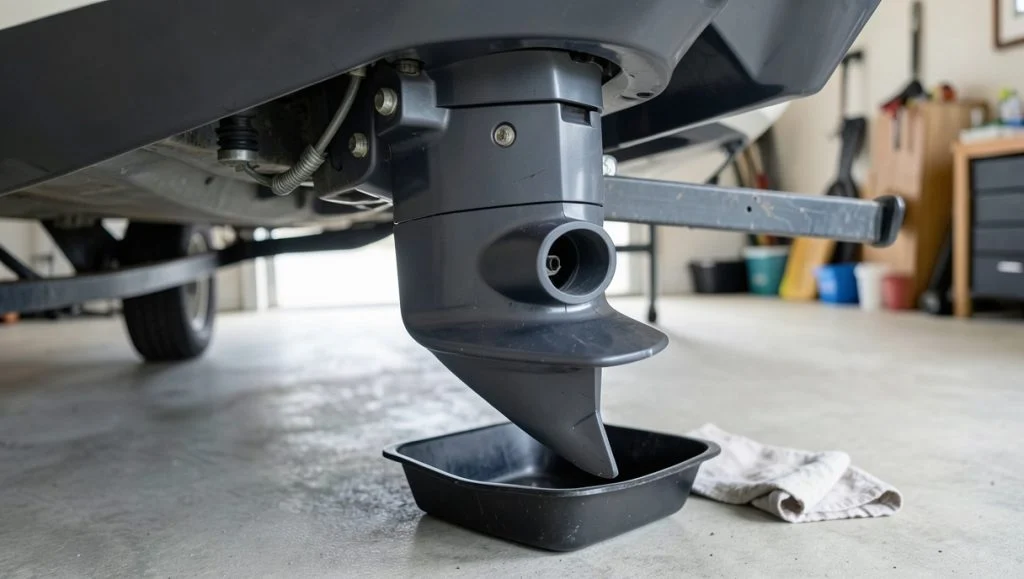
- Trim the engine fully down so the gearcase is vertical.
- Put a clean drain pan under the gearcase.
- Remove the bottom drain/fill screw, then the top vent screw. Opening the vent lets the oil drain fully.
- Let it drain. Check the old lube’s color and look for metal on the drain screw magnet, if it has one.
- Thread the lube pump (or tube) into the bottom hole. Pump until lube flows out of the vent hole with no air bubbles.
- Install the vent screw with a new sealing washer first. This holds the oil in while you work.
- Remove the pump and quickly install the bottom screw with a new sealing washer.
- Tighten both screws to the torque in your service manual. Do not overtighten.
- Wipe the gearcase clean and check for drips after a short wait.
What Does Milky Gear Lube Mean?
Milky or creamy gear lube means water has mixed with the oil. This is the most common sign of water intrusion.
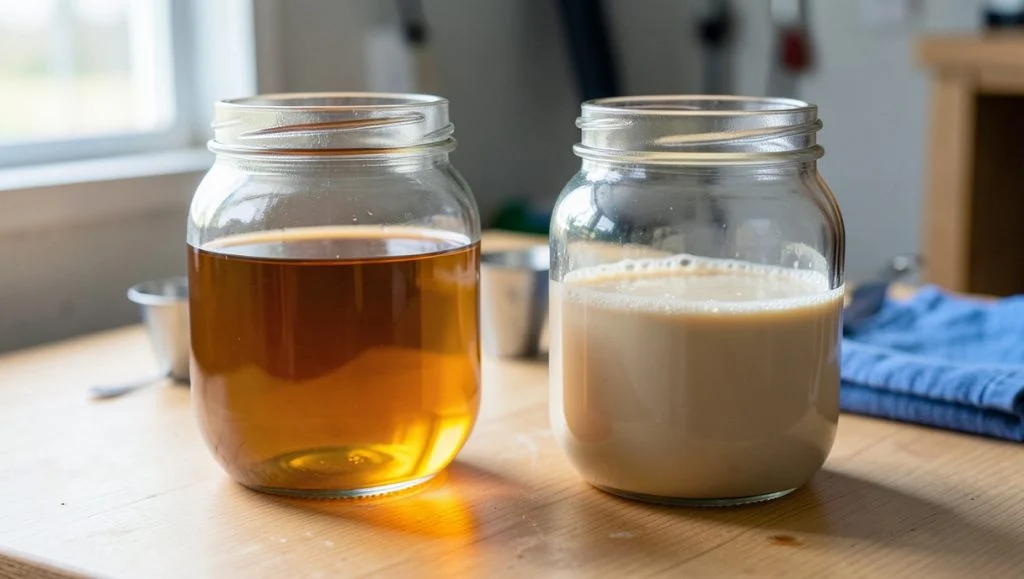
What to do:
- Change the lube right away. Do not keep running on milky lube.
- Check the seals. Look at the drain and vent screw washers first, since they are cheap and easy to replace.
- Look for fishing line wrapped behind the propeller. It can damage the prop shaft seal.
- If the lube turns milky again soon after a change, have a dealer pressure test the gearcase and replace seals as needed.
Will Non-Mercury Gear Lube Affect Your Warranty?
Read your engine’s warranty terms. The safest choice is the lube grade and spec your owner’s manual calls for. Keep receipts and a log of each change with the date and engine hours. That record helps if you ever need to file a claim.
How to Handle and Dispose of Used Gear Oil
- Wear gloves. Gear lube is messy and has a strong smell.
- Never drain it into the water, onto the ground or down a drain.
- Pour used lube into a sealed container. An empty oil bottle works.
- Take it to a used oil recycling point. Many auto parts stores, marinas and local recycling centers accept it.
- Bag oily rags and dispose of them per local rules.
Final Words
We have come to the end of the Mercury High-Performance Gear Lube vs. Quicksilver discussion. The short version: they are the same SAE 90 oil from Mercury Marine, sold under two labels. Choose by grade, not brand name. Use Premium 80W-90 for outboards under 75 HP, High Performance SAE 90 for 75 HP and up, and always defer to your owner’s manual.
Related Posts:
- Best Fuel Sending Unit for Boat: (Top 7 Picks In 2021)
- Marine Mat vs. Seadek: Need to Know Before Installed
- Lakemaster vs. Lakemaster Plus: Which Is The Best Mapping Card
- Carolina Skiff vs. Boston Whaler: Detailed Comparison
- 3M 4200 vs. 5200 Underwater Sealant: Stop Any Leaks
Frequently Asked Questions
Who makes Quicksilver gear lube?
Mercury Marine makes Quicksilver gear lube. Quicksilver is not a separate company. It is Mercury Marine’s own brand of aftermarket parts, oils and accessories, sold through Mercury dealers and retail stores. When Mercury sells the same oil under its own name, it is labeled Mercury High-Performance Gear Lube.
What sizes does Quicksilver High Performance gear lube come in?
Quicksilver High Performance SAE 90 gear lube comes in 8 oz, 32 oz and 2.5 gallon sizes. A 32 oz Gear Lube and Pump Kit is also sold. If you are changing your own lower unit lube for the first time, the kit saves you from buying a pump separately.
What does the "W" mean in 80W-90 gear oil?
The "W" marks the cold-temperature (winter) rating in a multigrade oil. In 80W-90, the 80W is the cold rating. The 90 is the viscosity grade at 100°C under the SAE J306 standard. A single-grade oil like SAE 90 has only the hot-temperature grade and no "W" rating.
Is a thicker gear oil better for an outboard lower unit?
No, a thicker gear oil is not automatically better. A higher viscosity number only means the oil is thicker at a set test temperature. It does not mean the oil protects better or stays in place. Thicker oil is only the right choice if your engine maker calls for that grade.
Why is gear lube filled from the bottom of the lower unit?
Gear lube is filled from the bottom so air can escape out the top vent hole. You pump lube into the lower drain/fill hole until it flows out of the vent with no air bubbles. This helps fill the gearcase fully. Then install the vent screw first, followed by the bottom screw.