
Quick answer: Yes, Lund boats are good aluminum fishing boats. Lund has built boats in New York Mills, Minnesota, since 1948. The brand is known for rough-water multi-species hulls and strong resale value. Lund boats cost more than many aluminum brands, so check the riveted seams and older transoms before you buy one used.
Are Lund boats good? The short answer
Lund is one of the longest-running aluminum fishing boat brands in North America. Its boats are built for big, choppy water and for anglers who fish many species. They also have a reputation for holding their value. You pay for that reputation, because Lunds usually cost more than value-focused aluminum boats.
A Lund suits serious anglers who fish large lakes and plan to keep the boat for years or sell it later. The main caveats are the riveted seams, which can weep with age, the price premium, and the transoms on older models.
One note on resale: the strong resale claim comes from Lund itself. It has not been independently verified. Treat it as a selling point to check against local used-boat listings.
Who makes Lund boats and where are they built?
Brunswick Corporation owns Lund Boats. It bought the brand in 2004.
The company started in 1948. Howard Lund couldn’t find a quality duck boat to hunt from, so he built one in New York Mills, Minnesota (Lund Boats). G. Howard Lund died in 2003 at age 91 at his home in Detroit Lakes, Minnesota (Boating Industry). Lund marked its 75th anniversary in 2023.
- 1948: Lund begins in New York Mills, Minnesota.
- 1972: Lund expands manufacturing to Steinbach, Manitoba (Boating Industry Canada).
- Before 2004: Lund is part of the Genmar group.
- 2004: Brunswick Corporation acquires Lund.
Why does Brunswick ownership matter to buyers?
Brunswick also owns Mercury Marine. Because of that, Lund boats are commonly sold as packages with Mercury outboards. For buyers, the practical benefits are a large dealer network and simpler service when the boat and the engine come from the same corporate family. Ask your dealer which engine options and package deals are available on the model you want.
How are Lund boats built?
Lund fishing boats use riveted aluminum hulls. Lund puts its lifetime warranty on the double-riveted seams, the transom and the flooring (Lund). Newer models use HDP composite transoms instead of wood.
Here is an example of how Lund builds a larger boat. In a Woods & Waters review, the 2075 Pro-V Bass had these specs:
| Spec | Lund 2075 Pro-V Bass |
|---|---|
| Length | 20’10” |
| Beam | 96″ |
| Max horsepower | 250 hp |
| Fuel capacity | Up to 49 gal |
| Approx. weight | 1,850 lb |
| Top speed in review | About 65 mph (250 hp Mercury) |
| Bottom | Twin-plated (standard) |
Riveted vs. welded: what it means for you
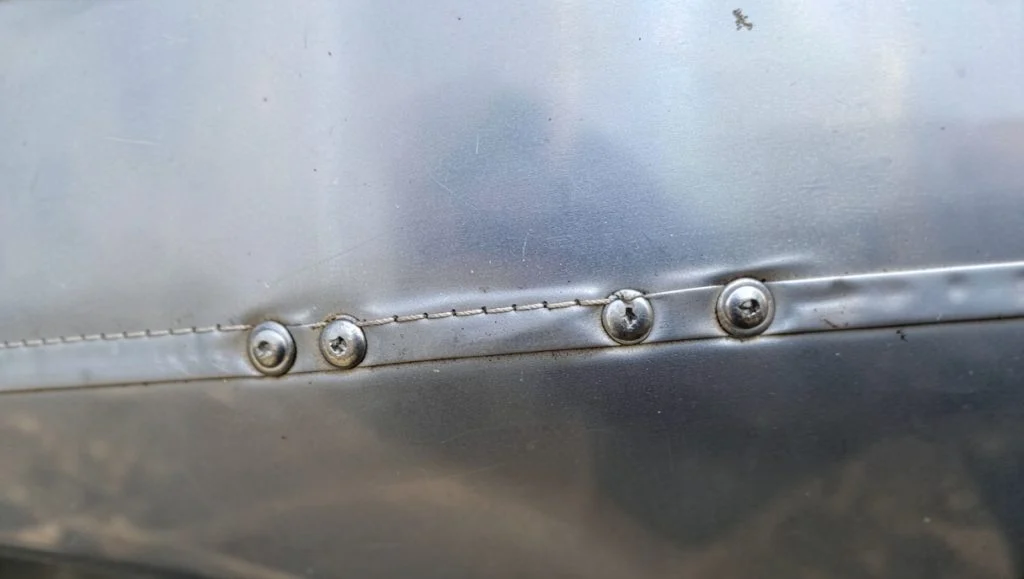
Lund boats are riveted, not all-welded. Both methods can make a good boat. Each one fails in its own way.
| Riveted hull | Welded hull | |
|---|---|---|
| How it handles stress | Seams can flex a little in waves | Rigid, one-piece seams |
| Typical aging issue | Rivets can loosen and weep over time | Welds can crack under stress or impact |
| Repair | Loose rivets can often be replaced or tightened | Cracks need skilled aluminum welding |
| What to check | Weeping rivets and oxidation trails | Cracks near welds, the transom and stress points |
The bottom line: a riveted hull is not weaker by default. Just check the seams carefully on any used riveted boat.
What is an HDP transom?
The transom is the flat back wall of the boat that holds the outboard. HDP stands for high-density polyethylene, a composite plastic. Lund describes its HDP composite transoms as completely weatherproof, and its lifetime warranty covers them (2022 Lund catalog). Unlike wood, HDP does not rot when water gets in.
What does the Lund warranty cover?
Lund advertises a Lifetime Limited Warranty on its fishing boats (2023 Lund catalog). According to Lund, the coverage includes:
- Lifetime coverage on double-riveted seams, the transom and flooring.
- 3-year bow-to-stern coverage.
Lund says its dealers have the full details. Terms, exclusions and transfer rules can change by model year. Before you buy, get the warranty document that applies to that exact boat and year.
Is the Lund boat warranty transferable?
The verified sources here don’t confirm it, so ask Lund or a dealer and get the answer in writing. This matters because transfer rules differ by brand. For example, Crestliner’s welded hull seam warranty is not transferable (Crestliner 2024 warranty). If you are buying a used Lund, assume you have no lifetime coverage until the transfer terms are confirmed.
What are the most common Lund boat problems?
Most Lund problems come from age and hard use, not from design flaws. Treat each item below as something to check, not as a sign that the boat is bad.
Rivet leaks
On older or hard-used hulls, rivets can loosen and weep water. Pounding through big waves and rough trailering speed this up. Look for “smoking” rivets, which leave dark oxidation trails on the hull. Small weeps can often be fixed. Many leaking rivets may point to deeper hull stress.
Transom condition on older boats
Older Lunds built before composite transoms used wood. A wood transom can rot if water gets in around the bolt holes. Find the boat’s model year and confirm which transom it has. Then check it for flex, as described in the checklist below.
Livewell, bilge and wiring wear
These issues show up on all aluminum fishing boats, not just Lunds. Pumps wear out, wiring corrodes, and carpet or flooring breaks down. These repairs are usually manageable. Still, factor their cost into your offer.
Are Lund boats worth the money?
Lund boats are worth the money for anglers who fish big water and plan to resell. Lunds are priced above value-focused aluminum brands. Prices vary by model, engine and dealer, so compare written quotes from more than one dealer.
Do Lund boats hold their value?
Lund says they do. As reported by Woods & Waters, Lund says it is not uncommon for owners who have had their boat for 5 to 10 years to get their original cost back when they sell. Lund also credits its lifetime warranty for part of that value. This is a manufacturer claim. To test it, compare used Lund listings near you with the original prices of similar models.
Decision rule: when the premium makes sense
- Buy a Lund if you fish big, rough lakes, chase several species, or plan to sell the boat within about 5 to 10 years.
- Consider a cheaper brand if you fish small lakes, go out only a few times a year, or plan to keep the boat until it wears out.
Which Lund boat is right for you?
Match the series to how and where you fish. Model names and lineups change, so confirm current models on lundboats.com before you shop.
| Your use | Lund series family | Why it fits |
|---|---|---|
| Small lakes, rivers, budget-minded fishing | Tiller and utility models | Simpler, lighter boats with a tiller outboard |
| Walleye and mixed species on big water | Multi-species (Pro-V, Tyee, Crossover XS) | Deep-V hulls built for chop, with room for gear |
| Bass fishing and tournaments | Pro-V Bass | Bass layout with high horsepower ratings |
| Smoother ride, glossy finish | Fiberglass models | A non-aluminum option within the brand |
How do you inspect a used Lund before buying?
Use this checklist on any used Lund. If possible, bring a marine mechanic for a paid survey.
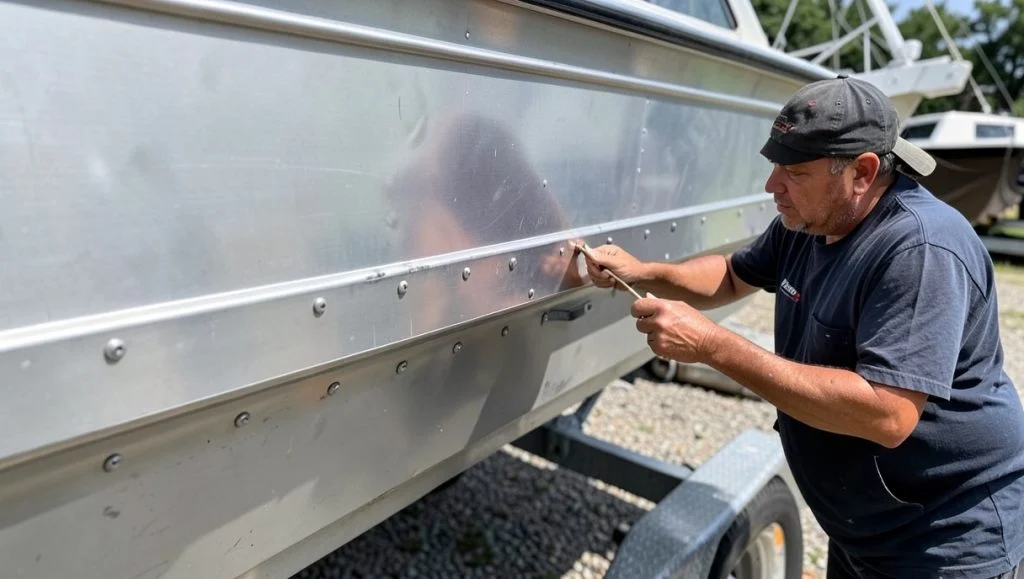
- Test the hull for leaks. With the boat on the trailer, add water inside or spray the inside of the hull with a hose. Look underneath for drips at seams and rivets.
- Look for “smoking” rivets. Black or gray oxidation trails around rivets point to movement or weeping.
- Flex the transom. Grab the lower unit of the outboard, then push and pull. The transom should not bend, crack or creak.
- Walk the floor. Step across the whole deck. Soft or spongy spots can mean rotted or damaged flooring.
- Run the livewell and bilge pumps. Make sure each pump turns on, moves water and shuts off properly.
- Inspect the wiring. Look for green corrosion, melted insulation, loose connections and amateur splices.
- Check engine hours and service records. Ask for receipts for oil changes, lower unit service and winterizing.
- Confirm warranty transfer. Get the boat’s model year and hull ID. Then ask a Lund dealer, in writing, whether any coverage transfers to you.
Lund vs. other aluminum fishing boat brands
Lund is not automatically better than Crestliner or Alumacraft. The right choice depends on build method, price and dealer support near you. The biggest difference to compare is build approach:
- Lund: Riveted hulls with a lifetime warranty on double-riveted seams. Priced at the upper end of aluminum fishing boats.
- Crestliner: Offers welded hulls. Its welded hull seam warranty is not transferable, which matters if you buy used.
- Alumacraft and others: Check each model’s hull construction and warranty terms directly. They vary by brand and model year.
For full breakdowns, see our brand reviews: [INTERNAL LINK: Crestliner review] and [INTERNAL LINK: Alumacraft review]. When comparing, put the same three questions to each dealer: How is the hull joined? What does the structural warranty cover? Does it transfer to the next owner?
Lund Boats FAQ
Are Lund boats good for rough water?
Yes. Lund is known for rough-water multi-species hulls built for big, choppy lakes. Its multi-species series, such as Pro-V, Tyee and Crossover XS, use deep-V hulls made for chop, with room for gear. Hard pounding through big waves can loosen rivets over time, so check the seams on any used Lund.
Does Lund make fiberglass boats?
Yes. Lund is best known for riveted aluminum fishing boats, but it also offers fiberglass models. They give a smoother ride and a glossy finish while staying within the Lund brand. Model names and lineups change, so confirm the current fiberglass models on lundboats.com before you shop.
Do Lund boats have wood transoms?
Newer Lund models use HDP composite transoms, not wood. HDP is high-density polyethylene, which does not rot, and Lund’s lifetime warranty covers it. Older Lunds built before composite transoms used wood, which can rot if water gets in around the bolt holes. Confirm the model year and flex-test the transom on any used boat.
How fast is the Lund 2075 Pro-V Bass?
In a Woods & Waters review, the Lund 2075 Pro-V Bass reached about 65 mph with a 250 hp Mercury outboard. That boat is 20’10" long, has a 96-inch beam and a 250 hp maximum rating. It weighs about 1,850 pounds and has a twin-plated bottom as standard.
Is a Lund worth it for casual fishing on small lakes?
Often not. A Lund’s price premium makes the most sense for anglers who fish big, rough lakes, chase several species, or plan to sell within about 5 to 10 years. If you fish small lakes a few times a year and will keep the boat until it wears out, a cheaper aluminum brand may fit better.

Leave a Reply