Quick answer: Neither aluminum nor galvanized is better in every case. Aluminum costs more, weighs less, and gives better payload and gas mileage. Galvanized steel is stronger and costs less up front. Both work well in salt water if you rinse them with fresh water after every launch. Painted steel is best kept for fresh water only.
For boat owners, a trailer is an important addition to the boat. It lets you carry your boat on the road, launch it at the ramp, and pull it back out of the water.
Steel trailers are the oldest type of boat trailer and are used all over the world. In the 1970s, aluminum trailers brought strong competition to the market. Plain steel is prone to rust, and aluminum gave owners a way around that problem.
Galvanizing changed the picture. It greatly reduces the rust and corrosion problems of steel trailers.
Galvanized trailers are steel trailers protected by a layer of zinc coating to reduce rust and corrosion. With two good options, choosing one can be hard. Many boat owners ask, Aluminum Trailer vs. Galvanized Trailer: Which is Better? Below, we compare the two to help you find the right one for your boat and your water.
Aluminum vs. Galvanized Trailers: Comparison Chart
Both aluminum and galvanized trailers are in high demand. Each has advantages and disadvantages, so the better pick depends on your boat, your budget, and where you launch.
Here is a side-by-side comparison of the two trailer types.
| Aluminum Trailer | Galvanized Trailer |
| Many aluminum trailers use 6000-series alloys such as 6061, which is roughly 96–98.5% aluminum. | Galvanized Trailers consist of a protective zinc layer on steel. |
| Aluminum does not rust, but it can oxidize and corrode in salt water. It is generally rated as the most corrosion-resistant common trailer material. | Galvanized Trailer also provides effective protection against rust and corrosion, and is a standard choice for salt water. |
| Aluminum Trailers are lightweight. | Galvanized Trailers are heavier than the Aluminum ones. |
| It provides better payload capacity. | It provides less payload capacity than the Aluminum ones. |
| Steel is stronger, so aluminum is the less strong of the two. | Galvanized steel trailers are the strongest type of boat trailer. |
| Aluminum Trailers are more expensive to purchase. | Compared to the Aluminum ones, Galvanized Trailers are less expensive to purchase. |
| Aluminum Trailers are more economical to fuel usage. | Galvanized Trailers are less economical in fuel usage. |
| Needs a fresh-water rinse after every use in salt water. | Needs a fresh-water rinse after every launch or load in salt water. |
Difference Between Aluminum and Galvanized Boat-Trailers:
Many aluminum boat trailers are built from 6000-series alloys such as 6061. According to the Aalco 6061-T6 datasheet, 6061 is about 95.85–98.56% aluminum. Its main alloying elements are magnesium (0.8–1.2%) and silicon (0.4–0.8%). It also has small amounts of copper (0.15–0.4%), chromium, iron, and zinc (up to 0.25%).
On the other hand, Galvanized Trailers consist of a coated zinc layer on the steel alloy. As steel is generally stronger than aluminum, the Galvanized Trailers are believed to be stronger than Aluminum Trailers.
Here we will compare some aspects of Aluminum and Galvanized boat trailers right below.
Weight and Payload: Which Trailer Lets You Carry More?
Steel is a heavy iron alloy. Aluminum is much lighter. For this reason, steel or galvanized boat trailers are heavier than aluminum trailers.
A lighter trailer helps in several ways. Lightweight aluminum trailers give you better payload capacity, as Boating Magazine notes. A galvanized trailer uses up more of the allowed total weight on its own frame. That leaves less room for the boat, engine, fuel, and gear. A lighter trailer also improves your tow vehicle’s gas mileage.
Strength: Is a Galvanized Trailer Stronger Than an Aluminum One?
Yes. Galvanized steel trailers are heavier and stronger than aluminum ones. Steel or galvanized trailers are the strongest type of boat trailer. That makes them a solid choice for heavy boats and hard use.
Aluminum trailers can still be built to carry heavy boats. The maker sizes the frame for its rated capacity. What matters most is that the trailer is rated for your total load, not which metal it uses.
Whichever you choose, stay within the rated capacity. A well-built trailer of either type, used within its rating and cared for, can give you years of service.
Rust and Corrosion: Is Aluminum Really Rust-Free?
Aluminum does not rust, because rust is iron oxide and aluminum has no iron to speak of. But aluminum does oxidize. It can corrode in salt water and leave a powdery white residue. Aluminum is generally rated as having the best corrosion resistance of the common trailer materials. It still needs a fresh-water rinse after every use.
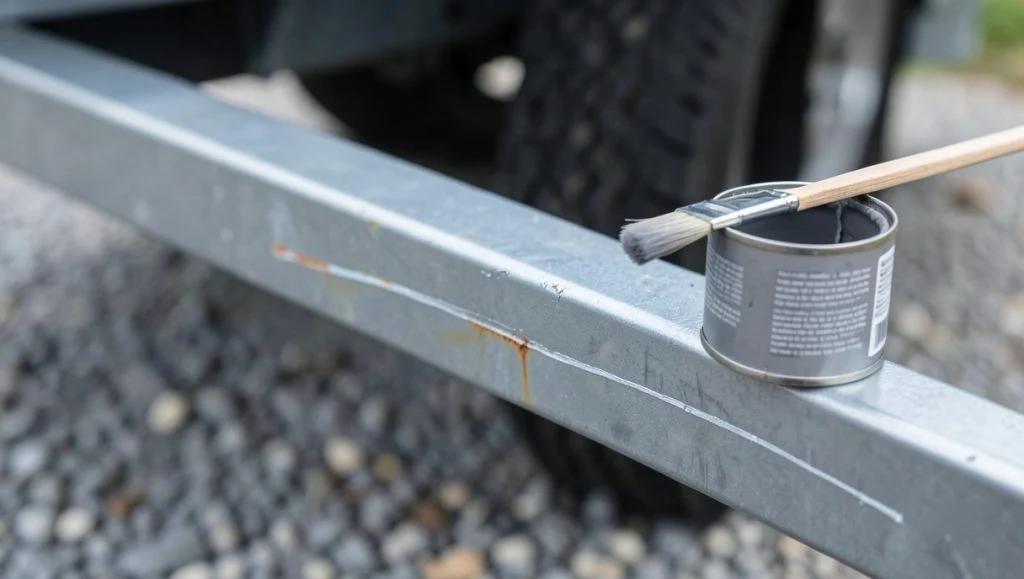
The main purpose of galvanizing is to stop rust. The zinc layer on the steel does more than act as a barrier. If the coating gets scratched, the zinc corrodes in place of the nearby bare steel. This is called cathodic protection.
This means a small scratch is not a crisis. According to the American Galvanizers Association, zinc fully protects bare spots up to about 2 mm wide in urban air and up to about 5 mm in industrial-marine climates. Wider damage gets only partial protection and can rust. Larger damaged areas should be touched up following ASTM A780.
So, if corrosion is your top concern, aluminum has a slight edge. But galvanized steel holds up well too, as long as you rinse it and fix larger coating damage.
Repair and Maintenance: What Does Each Trailer Need?
Repair options differ between the two metals. Aluminum and steel call for different welding skills and equipment. Before you buy, ask a local trailer shop whether it repairs aluminum frames, galvanized frames, or both.
For galvanized trailers, be careful with the zinc layer during any repair. Touch up larger damaged areas per ASTM A780 so the steel stays protected.
Routine care is simple for both types:
- Rinse the trailer with fresh water after every use, especially after salt water.
- Grease the rollers.
- Grease the light sockets to fight corrosion.
- Check the zinc coating on galvanized trailers and touch up larger bare spots.
Acid brighteners for aluminum are optional. They only change how the trailer looks. They are not required maintenance.
Keep in mind that the frame is not the only part exposed to water. Bearings, brakes, axles, springs, lights, and bolts face the same salt water. They need regular checks no matter which frame material you pick.
Cost: How Much More Does an Aluminum Trailer Cost?
Aluminum boat trailers cost more to buy than galvanized boat trailers. The exact gap depends on the size, brand, axles, and features. Get quotes for the same size and capacity in both materials to see the real difference for your boat.
For this reason, budget-minded boat owners often choose galvanized steel trailers. Aluminum can still be worth the extra money if you want lower weight, better payload, and better gas mileage.
When you compare prices, also compare warranties. Read what each warranty covers, how long it lasts, and whether it covers corrosion of the frame and running gear.
How Long Does a Galvanized Boat Trailer Last?
There is no fixed number of years. Lifespan depends on how often you launch in salt water, how well you rinse the trailer, and whether you fix coating damage. A galvanized trailer that is rinsed after every launch and touched up when needed will last far longer than one that is ignored.
Resale
Resale value depends mostly on condition. A clean trailer with sound bearings, brakes, lights, and frame will sell better than a neglected one, whatever it is made of.
Keep your maintenance records. Regular rinsing, greasing, and coating touch-ups help either trailer type hold its condition over the years.
Is Aluminum or Galvanized Better for Salt Water?
Both aluminum and galvanized steel are good picks for salt water. Aluminum is generally rated as the most corrosion-resistant common trailer material. Galvanized steel is a standard saltwater choice and resists corrosion well.
The bigger factor is care. In salt water, either trailer will last longer if you rinse it after every launch.
Should I Rinse My Boat Trailer After Every Saltwater Launch?
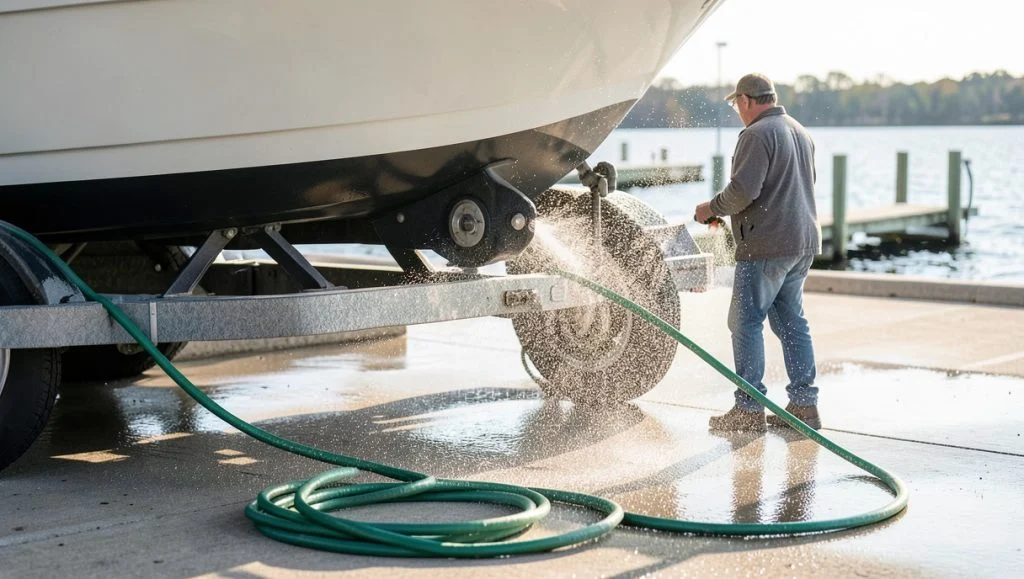
Yes. Boating Magazine advises rinsing galvanized trailers with fresh water after every launch or load. It gives the same advice for aluminum trailers and any trailer used in a marine environment.
A simple routine after a saltwater trip:
- Rinse the whole frame with fresh water as soon as you can.
- Spray the axles, springs, brakes, and hubs, where salt hides.
- Rinse the rollers or bunks and the winch area.
- Look for white residue on aluminum or bare spots on galvanized steel.
- Grease rollers and light sockets on your regular schedule.
Can You Use Stainless Steel Bolts on an Aluminum Trailer?
Be careful when different metals touch. In salt water, one metal can corrode faster than the other. This is called galvanic corrosion. It is the same effect that lets zinc protect steel on a galvanized trailer, but on an aluminum frame the aluminum may be the metal that suffers.
Watch the spots where steel axles, springs, brackets, or bolts meet an aluminum frame. Use the hardware your trailer maker specifies. Ask the maker what it recommends before swapping in different fasteners.
What About Painted Steel or Other Trailer Options?
Painted steel trailers are the cheapest option. But they corrode readily in salt or brackish water. They are best kept for fresh water.
So, is a painted steel trailer OK for fresh water? Yes, if you only launch in fresh water and want the lowest price, painted steel is a reasonable choice. If you ever plan to launch in salt or brackish water, choose aluminum or galvanized instead.
If you choose galvanized, ask the seller how the frame was coated. The ASTM A780 repair guidance above is written for hot-dip galvanized coatings.
How Do You Match a Trailer to Your Boat?
Frame material matters less than getting the capacity right. Follow these steps:
- Add up the boat’s dry weight, engine, fuel, batteries, and gear. This is your real load.
- Choose a trailer whose load capacity covers that total with room to spare.
- Add the trailer’s own weight to the loaded boat weight. The total must stay within the trailer’s GVWR (gross vehicle weight rating).
- Check that the same total is within your tow vehicle’s towing capacity.
- Check your state’s rules on trailer registration, brakes, and lighting before you buy.
This is where aluminum’s lower weight helps. A lighter trailer leaves more of the GVWR and towing capacity for the boat itself.
Aluminum vs. Galvanized Boat-Trailers: Which to Buy?
Both aluminum and galvanized boat trailers have advantages and disadvantages. The right choice depends on your budget, your boat, and where you launch.
Aluminum trailers cost more to buy. In return, you get lower weight, better payload, and better gas mileage. Galvanized trailers cost less and are stronger. Both need a fresh-water rinse after saltwater use, and both need care for their bearings, brakes, and lights.
Use this table to decide:
| If this sounds like you… | Consider |
| You want the lowest price and launch in salt water | Galvanized steel |
| You tow a heavy boat and want the strongest frame | Galvanized steel |
| You want better payload and gas mileage, and cost is not a big concern | Aluminum |
| You want the best corrosion resistance for salt water | Aluminum |
| You only launch in fresh water and want the cheapest option | Painted steel |
| Your tow vehicle is close to its towing limit | Aluminum, for the lower trailer weight |
Steel or Galvanized Trailers are the strongest trailers. They can carry heavy loads. Aluminum trailers are lighter, so they give you better payload capacity. The lighter weight also means better gas mileage for your tow vehicle.
In the end, aluminum has an edge if weight, fuel use, and corrosion resistance matter most and cost is not your main concern. Galvanized steel is the better value if you want strength at a lower price. Whichever you choose, rinse it after every saltwater launch and keep up with basic maintenance.
Related Posts:
- Simrad vs. Garmin Fish Finder: Detailed Comparison
- Star Tron vs. Sta-Bil Fuel Stabilizer: Detailed Comparison
- Costa vs. Oakley sunglasses – Which one to choose?
- Motorguide Tour Pro vs. Ultrex: Detailed Comparison
- Rhodan vs. Minn Kota Trolling Motors: What are the Differences
Frequently Asked Questions
Do aluminum boat trailers corrode in salt water?
Yes, aluminum can corrode in salt water, even though it does not rust. Rust is iron oxide, and aluminum has almost no iron. Aluminum oxidizes instead and can leave a powdery white residue. It is still rated as the most corrosion-resistant common trailer material, but it needs a fresh-water rinse after every use.
Will a scratch on a galvanized boat trailer cause rust?
A small scratch usually will not cause rust. The zinc coating corrodes in place of the nearby bare steel. This is called cathodic protection. The American Galvanizers Association says zinc fully protects bare spots up to about 2 mm wide in urban air and about 5 mm in marine climates. Touch up larger damage following ASTM A780.
Do aluminum boat trailers need acid brightener?
No, acid brightener is optional for aluminum boat trailers. It only changes how the trailer looks and is not required maintenance. The care that matters is rinsing the trailer with fresh water after every use, greasing the rollers and light sockets, and checking the bearings, brakes, axles, springs, lights, and bolts.
Does an aluminum frame mean less trailer maintenance?
Not for the whole trailer. The frame is only one part exposed to water. Bearings, brakes, axles, springs, lights, and bolts face the same salt water on aluminum and galvanized trailers. They need regular checks either way. Both frame types also need a fresh-water rinse after every saltwater launch.
Does a lighter boat trailer improve gas mileage?
Yes, a lighter trailer improves your tow vehicle’s gas mileage. Aluminum trailers weigh less than galvanized steel trailers, so they are more economical on fuel. The lower weight also leaves more of the trailer’s GVWR and your vehicle’s towing capacity for the boat, engine, fuel, and gear.